MW4 DMZ is the extraction mode of Call of Duty: Modern Warfare 4. It is not free on its own, because it comes with Modern Warfare 4, which you have to buy. You deploy into Hajin, an open-world exclusion zone on the Korean peninsula, with a squad or on your own. There you fight AI forces and other players, complete missions, loot what you can carry and try to extract before the radiation or another squad gets you. What you extract is yours to keep, and what you lose when you die is mostly gone. DMZ launched with Modern Warfare 4 on October 23, 2026, after Early Access for digital pre-orders on October 20.
This page answers the basic questions first, then walks through how a run works, from the Forward Operating Base to the exfil. We built it on Activision’s June reveal and its two October intel guides on Hajin and the Forward Operating Base, and we have checked it against our own runs since Early Access. Where the game differs from the guides, we say so, and for the details of each system we link to our own guides.
Quick Answers: Free, PvE or PvP, Solo and Squads
Is MW4 DMZ free?
No. DMZ is a mode inside Modern Warfare 4, not a separate free download. Activision’s October 15 announcement says Modern Warfare 4 is a standalone release that you have to buy to play, and that it will not be included with Game Pass until Holiday 2027. Activision has not announced a free-to-play version of DMZ. That is a big difference from the original DMZ, which came free with Warzone 2.0.
To play, you need Modern Warfare 4 on PS5, Xbox Series X|S, PC (Steam, Battle.net or Xbox on PC) or Nintendo Switch 2. DMZ comes with the game, and the Vault Edition adds a third Operator slot and a Deployment Kit (see editions below). You don’t need Campaign or Multiplayer installed, and our guide on how to uninstall MW4 game modes shows how to drop them on every platform.
Is DMZ PvE or PvP?
Both, which is what people mean by PvPvE. Activision describes DMZ as a mode where you loot, complete objectives and fight both AI enemies and rival Operators. Every deployment has AI-controlled North Korean forces, drones, Lieutenants and Commanders, and other squads of real players on the same map. Those squads can fight you, leave you alone or call a Truce through the Ping Wheel. The threat level on your HUD only counts the AI, so a quiet Low area can still hold a squad waiting for you. Killing other players puts a Bounty on you that follows you across deployments.
Can you play DMZ solo?
Yes. Activision’s FOB guide says how you approach each deployment, within a squad or acting alone, is up to you. Squad Fill is a toggle in the Ready Up menu. Leave it on and the game fills your squad up to three players, switch it off and you deploy on your own. The one exception is Random Story Mission, which always uses Squad Fill. Solo, you can run into a full squad on your own. That makes the Stealth Meter and a threat level that cools off when you break contact more important. Traits help too, such as Possum, which gives you one self-revive into Last Stand per match, and our traits guide covers the rest.
How many players can be in a squad?
You deploy in a squad of up to three Operators. Bring your own party, or leave Squad Fill on and the game fills the empty spots with other players. Once you are in Hajin, the Ping Wheel lets you invite nearby players to join your squad or ask to join a nearby squad, and that way a squad can grow to a maximum of four. We finished Operation Signal Breaker in Songdo Wharf as a squad of four. Activision’s DMZ guides do not give these limits, so they come from our own runs.
How many players are in a DMZ match?
We can’t tell you. The game does not show a player count anywhere, and Activision has not given one for DMZ. What we can say is that every deployment has other squads of real players besides the AI, and that Infinity Ward built Hajin larger than Al Mazrah partly to spread squads out.
Is DMZ third person?
No. On foot in Hajin you play in first person, the same as Multiplayer. You walk around the FOB, the camp where you manage your gear between deployments, in third person, and in Hajin we drove vehicles from a third-person camera. None of the three deployment options (Story Missions, Dynamic Operations and Free Roam) is a third-person mode.
Does DMZ have bots?
Yes, as enemies. Hajin is full of AI-controlled North Korean soldiers in four tiers, drone swarms, robot dogs, helicopter patrols and road convoys, plus named Lieutenants and three types of roaming Commander. The full enemy roster is further down. There are no AI teammates. Squad Fill matches you with real players, and the rival Operators you run into are real players too.
What do you keep when you die?
Very little from that run. Your Operator goes Missing In Action, and you pay DMZ Cash at the Operators station to rescue them with their Traits, unspent Trait Points and Dog Tag rank, or you dismiss them and recruit a new one. Rescuing our own Operator cost $13,000 at Silver I and $65,000 later at Damascus III. Most of the loadout is gone, apart from what sat in a backpack’s Secure Slots, and a key you put in a Secure Slot survives too. Cash already in your Bank stays there, and the DMZ XP from the failed run still counts. Our FOB guide covers MIA rescue, and our keys guide lists every key and the door it opens.
What is MW4 DMZ?
DMZ is Call of Duty’s extraction shooter mode. You deploy into a hostile open-world map, complete objectives, gather loot, and try to extract before you die. Everything you extract comes back with you. Everything you lose when you die stays gone, unless it sat in a Secure Slot or you pay to recover your Operator.
The 2022 version shipped as part of Warzone 2.0 and was essentially a beta. Good concept, rough execution. Infinity Ward’s Studio Multiplayer Creative Director Geoff Smith described it bluntly: “It started as this crazy experiment, but it quickly became a proving ground.” The extraction shooter genre has exploded since then with Tarkov, Gray Zone Warfare, Hunt: Showdown, and Delta Force all competing for the same audience. MW4 DMZ needs to hold its own against dedicated extraction titles, not just be a fun side mode.
Co-Studio Head Jack O’Hara made one thing clear: “DMZ does not replace battle royale.” Warzone stays separate. DMZ is MW4’s third pillar alongside Campaign and Multiplayer. For the full picture on MW4’s other modes, see our MW4: Everything We Know overview.
Activision’s own framing in October is “Call of Duty’s definitive extraction shooter experience”: a persistent, open-world combat environment where you loot, complete objectives, fight AI forces and rival Operators, and hope to extract with your rewards. The studio says the mode has been in development for four to five years, running since the original DMZ was still live, and on the COD Pod it called Hajin the biggest map Infinity Ward has ever built.
How a DMZ Run Works
Every run follows the same loop, and the rest of this page follows it too.
- Gear up at the Forward Operating Base. Pick an Operator and fill your loadout from your Stash, the Vendor or the 3D Printer, or take the Free Loadout when you are short on cash.
- Pick a deployment at the Deploy station. That is a Story Mission, a Dynamic Op or Free Roam, and for the last two an infil that runs from a free ground drop to a cargo plane.
- In Hajin, work on your objectives and DMZ Orders, loot containers and compounds, and keep the threat level down. Other squads are on the map with you.
- Watch the radiation countdown. After roughly 30 minutes radiation starts spreading across the map, so get to an exfil before it reaches you.
- Extract and everything you carry goes back to the FOB, to sell, craft with or take in again. Die and your Operator goes MIA. Either way the After Action Report adds DMZ XP to your DMZ level and progress to your Operator’s Dog Tag.
Running through all of it are DMZ Orders, the pages of tasks that teach you the mode, unlock most of the FOB and lead into the Story Missions. Our DMZ Orders guide has every page, task and reward, and our MW4 DMZ hub lists every DMZ guide we have written.
Story Missions, Dynamic Ops and Free Roam

The Deploy menu offers three ways in, and you can mix activities once you are on the ground. Check your DMZ Orders at the FOB before deploying, or from the Orders page on the Tac-Map while in Hajin, because Activision points out that your orders and your squadmates’ orders may have objectives you can complete during the same mission.
Story Missions
Story Missions pick up after the fall of North Korea’s Supreme Leader, with a new threat filling the power vacuum in Hajin. They unlock after your first page of DMZ Orders and continue the campaign narrative inside live DMZ servers, so another squad can interfere with your objective. Matchmaking groups you with players doing the same mission. The Deploy menu lets you pick a specific mission, replay one, choose a random one, read a briefing, and see rewards, which are usually high-value gear and DMZ Cash, with extra rewards for completion milestones. Story missions will be updated seasonally, as confirmed on the PlayStation Blog.
Hajin launched with six Story Missions, and we have walkthroughs for all six. Operation Critical Extraction at Mirae General Hospital, Operation Silent Ledger at the Heavenly Luck Casino and Operation Shopping Hacks at NuriGO Mall each end a DMZ Orders chapter. The other three are Operation Iron Citadel at Chang-san Air Base, Operation Grid Assault at DBN Headquarters and Operation Fallen Ember at the Haneul reactor, which opens once Iron Citadel and Grid Assault are both done. Random Story Mission only picks missions you have already completed and always uses Squad Fill. Our DMZ hub lists all six walkthroughs in one place.
Dynamic Operations
Multi-step objectives with randomized steps. Pick one before infil or find a Dynamic Ops phone in Hajin to start one in the field. Completing an Op pays DMZ XP and DMZ Cash and calls in a Supply Drop whose loot quality climbs with each successful Op in the same deployment, from Common to Uncommon to Rare. The outcome stays the same, the path changes every run. The casino heist Infinity Ward showed in June turned out to be a Story Mission, Operation Silent Ledger. Our Dynamic Ops guide covers every op we have played since launch, with what each one paid at extraction.
Side Ops and Free Roam
Side Ops are lower-intensity tasks: locate lost Supply Drops, repair trucks, climb damaged radio towers to reveal a nearby Lieutenant, capture a SAM Site or activate a UAV Tower. Free Roam drops you in without a mission, and Activision recommends it for looting 3D Printer Ingredients, hunting Wanted Operators and grinding your DMZ Orders.
Activision’s own advice on balance is worth repeating: loot early (containers are one of the most reliable XP sources), but do not tunnel on it. Your end-of-deployment rating weighs Combat, Looting and Objectives together, and an S-Tier run needs all three.
Deploying: Infil Options and Prices
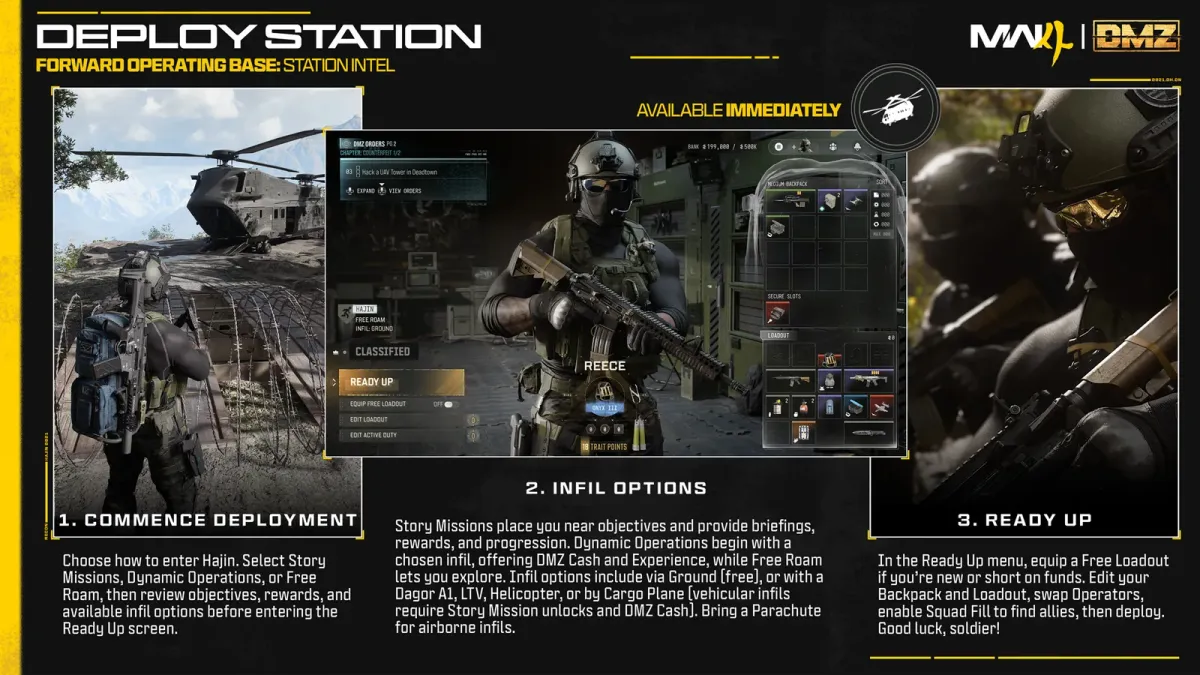
Dynamic Operations and Free Roam open up the paid infil system. We checked the prices below on the Select Infil screen in-game, and they match what Activision published. Each vehicle option unlocks through a Story Mission. Operation Silent Ledger unlocks the Polaris Dagor A1, Operation Iron Citadel the LTV, Operation Grid Assault the Helicopter and Operation Fallen Ember the Cargo Plane. In our own runs so far we have used the ground and helicopter infils.
| Infil | Cost | Unlocked by | What you get |
|---|---|---|---|
| Ground | Free | Available from the start | Random spot in Hajin, on foot. |
| Polaris Dagor A1 | 5,000 DMZ Cash | Operation Silent Ledger | Random spot, with a light vehicle air-dropped to you. |
| LTV | 25,000 DMZ Cash | Operation Iron Citadel | Random spot, with the heavily armored LTV air-dropped to you. |
| Helicopter | 50,000 DMZ Cash | Operation Grid Assault | Fly in from the FOB with one squadmate piloting. |
| Cargo Plane | 100,000 DMZ Cash | Operation Fallen Ember | Parachute drop onto an exact location of your choosing. |
Choosing where you land instead of a set random spawn was the thing we flagged as a game-changer back in June, and it is the most expensive option on the board. That feels right. Nobody should be able to drop onto the Air Base bunker for free every run.
Before you go, the Ready Up menu lets you equip the Free Loadout (basic gear you keep if you extract, ideal when you are broke), edit your Loadout, swap Operators and toggle Squad Fill. Activision’s recommended minimum is a Plate Carrier, a Backpack, a weapon and a Medkit. Your Armor slot fills with plates automatically on infil, and only Traits or an Armor Box Field Upgrade let you bring in more. As of October 27, Infinity Ward is investigating an issue where the Free Loadout can load you into the match without weapons, so check your loadout before you ready up.
Hajin: The Map and Its 13 POIs
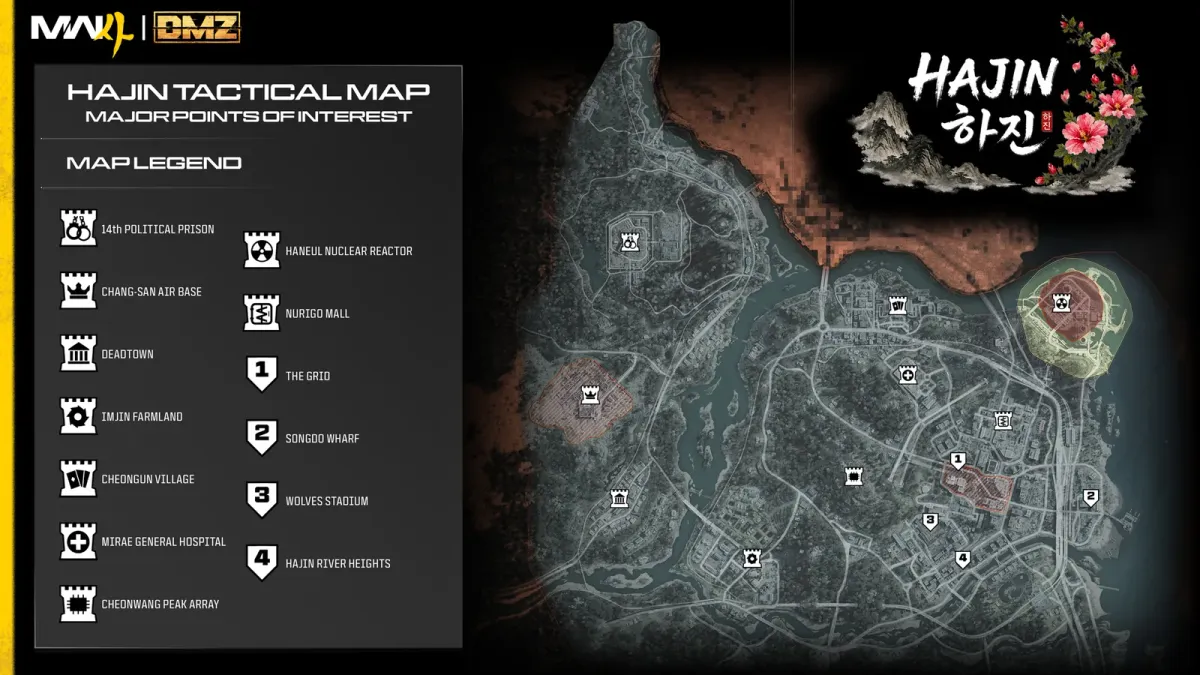
Hajin sits in a tri-point region bordering Russia and the Korean peninsula. It is DMZ’s map first, and from Season 1 it is also Warzone’s Battle Royale map (more on that below). The map is confirmed to be larger than Al Mazrah from Warzone 2.0, and every major point of interest is tagged as former North Korean (NK) or South Korean (SK) territory. That matters beyond the lore: NK fire stations are brick, SK ones look modern, and Activision suggests you use the architecture to work out where you are. Fire Stations are red, Police Stations blue and Clinics green, across the whole map.
Hajin launched without all of it. The Russian border north of Cheongun Village is described as fog-filled and currently inaccessible, and in a July interview with PCGamesN, Infinity Ward co-studio head Mark Grigsby said the Russian portion will be added in later seasons. No season number, no date.
How you read that depends on how you played the original. DMZ shipped Building 21, Ashika Island, Vondel and the Koschei Complex after launch, each one dragging the storyline somewhere new, so a region held back for a later chapter fits the pattern exactly. It also means part of the advertised map is a future update, in a mode people paid full price to get into. Both things are true.
The setting ties directly to the MW4 campaign. A nuclear reactor melted down during the war, creating the exclusion zone, and the Haneul reactor is still a live radiation hazard on the map. You operate as a shadow CIA asset deployed behind enemy lines to secure abandoned military tech before it falls into hostile hands. Grigsby was blunt about what the mode is: “It’s a game within the game.”
Every major POI and its threat level
Activision assigns an expected threat level to each point of interest, from Low to Extreme. That is the level before you start a fight. The table below starts from Activision’s list and adds the grid square from our own tac map. In two places the HUD showed something different in our runs. Activision’s guide lists NuriGO West as High and DBN Headquarters as Critical, but we saw Medium at NuriGO West and Extreme at DBN Headquarters, so the table uses what we saw.
| Point of Interest | Location | Grid | Expected threat |
|---|---|---|---|
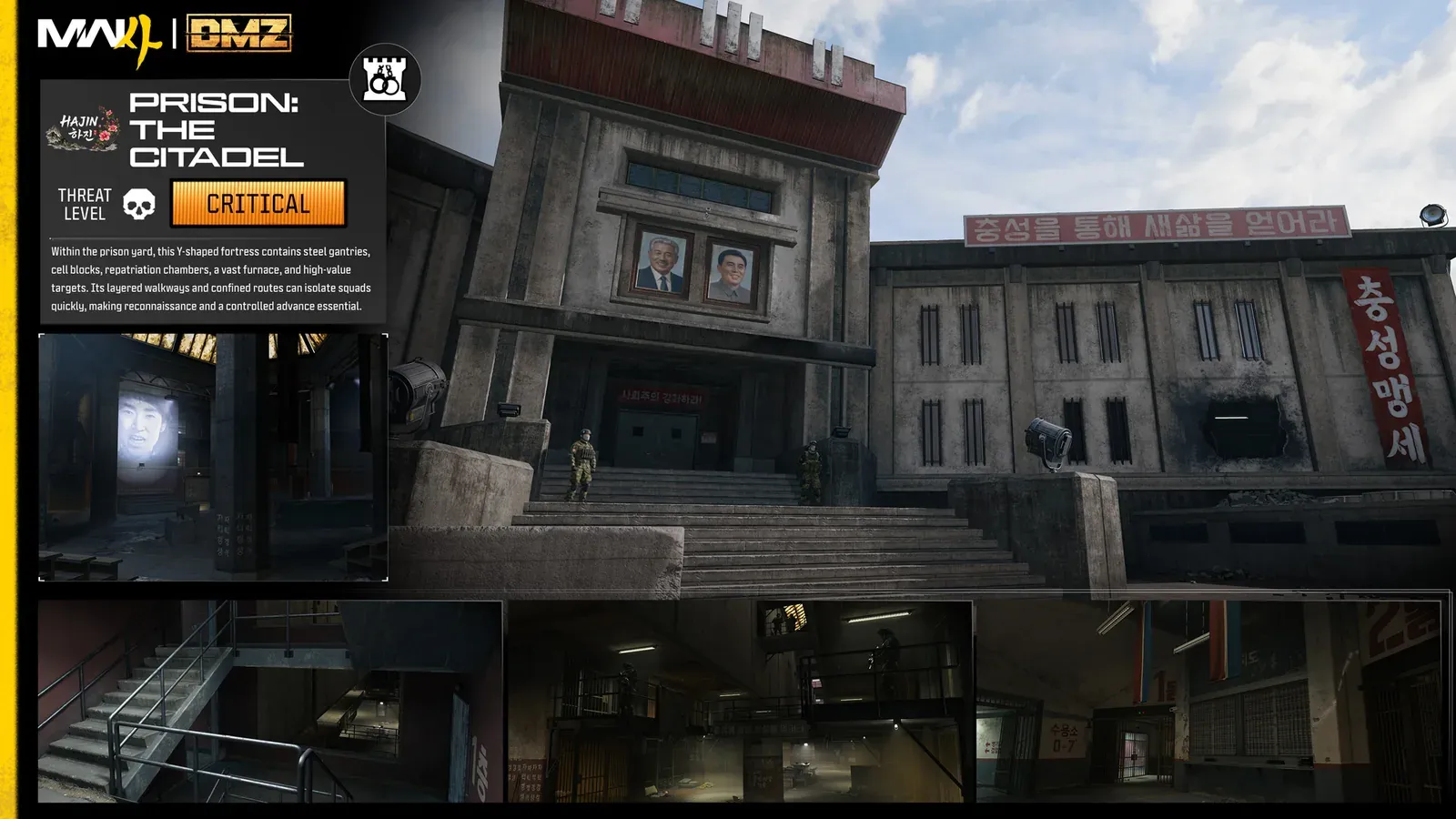
| 14th Political Prison | Northwest (NK) | C3 | High. The Citadel inside: Critical |
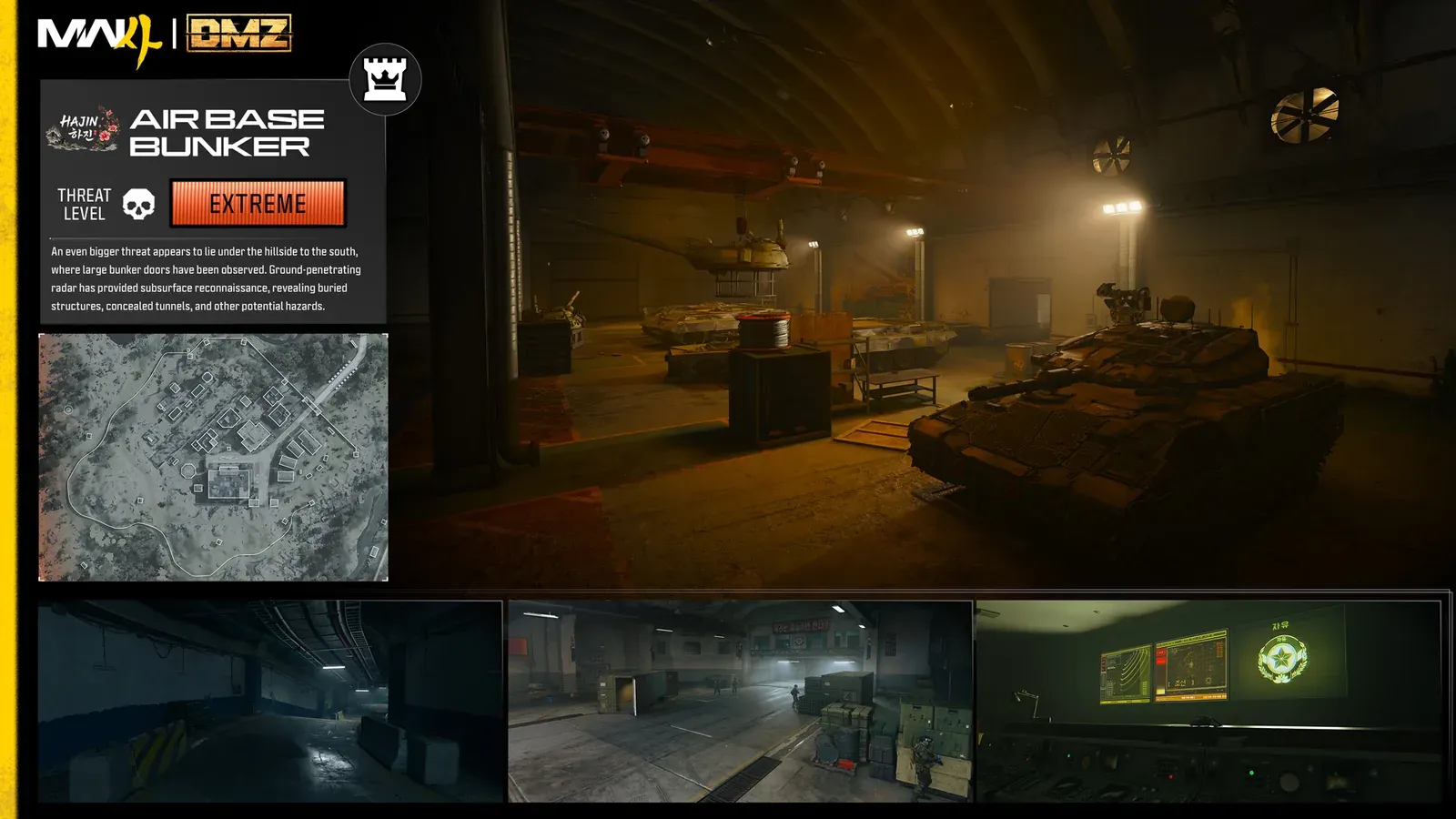
| Chang-san Air Base | West (NK) | B5 | Critical. Underground bunker: Extreme |
| Deadtown | Southwest (NK) | B7 | Low. Re-Education Center: Medium |
| Imjin Farmland | South-southwest (SK) | D7 | Low. Rice Mill: Medium |
| Cheongun Village | North (SK) | F4 | Low. Heavenly Luck Casino: High |
| Mirae General Hospital | North central (SK) | F5 | Low |
| Cheonwang Peak Array | Central (SK) | F6 | Medium |
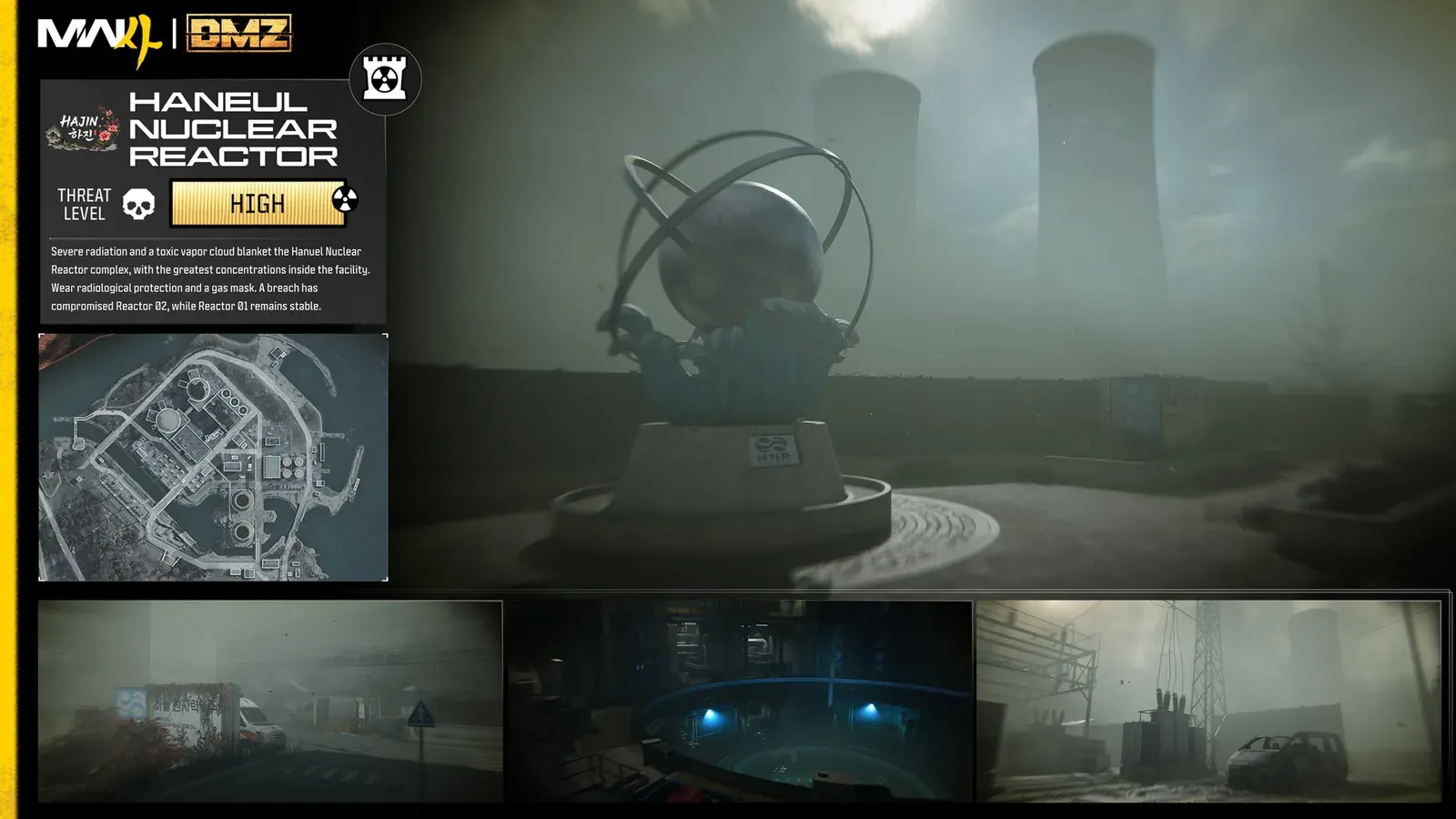
| Haneul Nuclear Reactor | Northeast (SK) | I4 | High, with radiation. Border Zone: Medium |
| NuriGO Mall | Northeast Hajin City (SK) | H6 | Mall: High. NuriGO West: Medium |
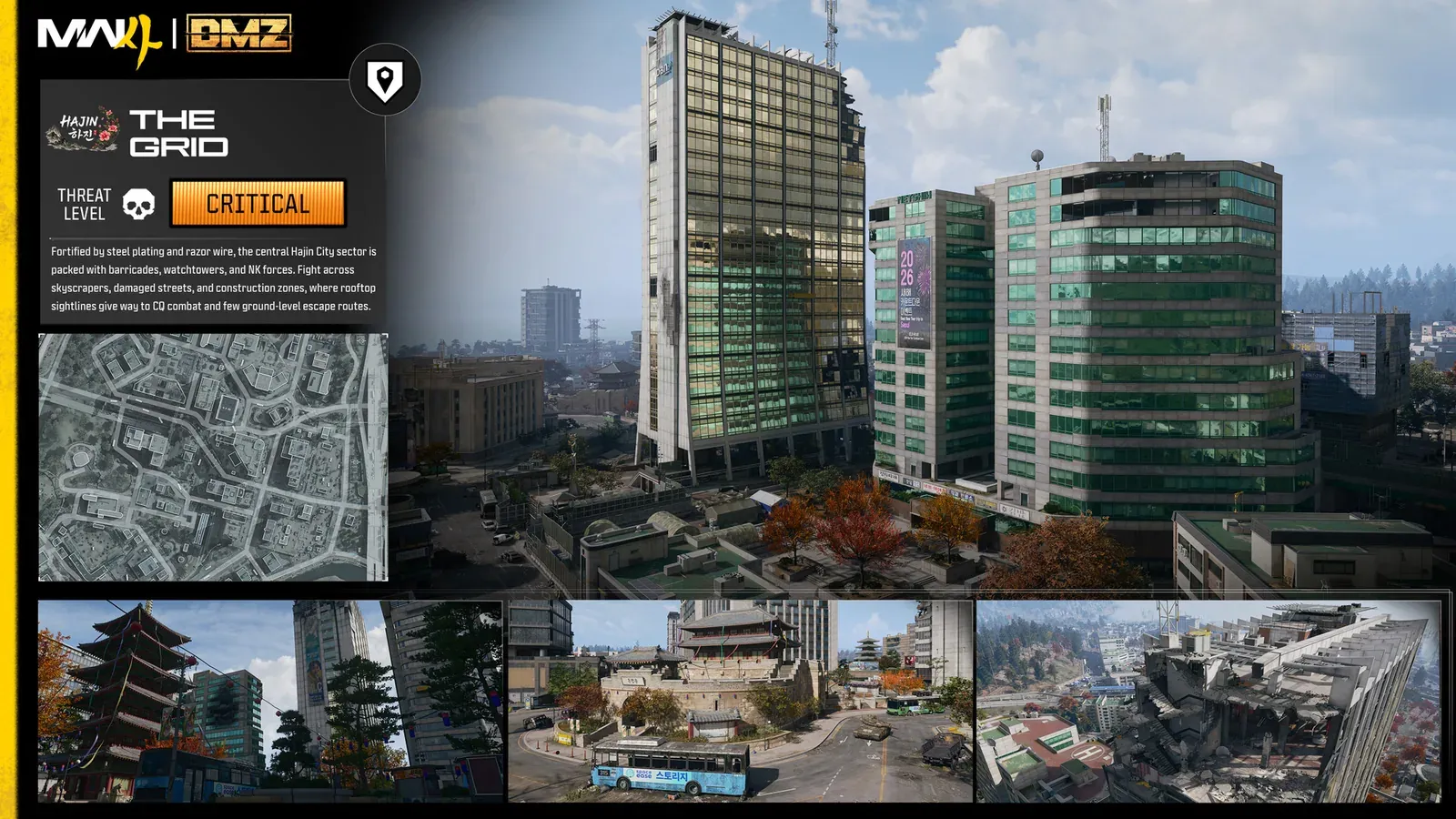
| The Grid | Central Hajin City (SK) | G6 | Critical. Netshin Tech Complex and DBN Headquarters: Extreme |
| Songdo Wharf | East Hajin City (SK) | I7 | Low |
| Wolves Stadium | South central Hajin City (SK) | G7 | Medium |
| Hajin River Heights | Southeast (SK) | G8 | Medium |
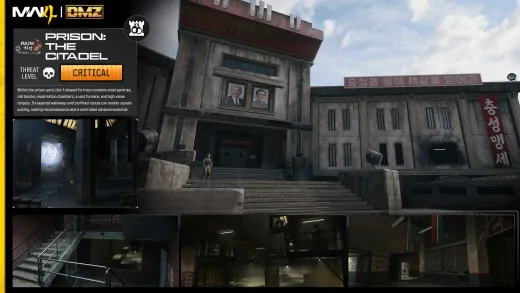 Click to enlarge Prison Citadel (Critical)
 Click to enlarge Air Base Bunker (Extreme)
 Click to enlarge The Grid (Critical)
 Click to enlarge Haneul Nuclear Reactor (High, radiation)
A few of these deserve a closer look before you drop in:
- The Grid is the fortified central business district of Hajin City, walled off with steel plating and razor wire. It holds DBN Headquarters and its TV tower (the tallest building on the map), the Hanex Bank tower, the Minsok Art School and the Netshin Tech Complex. DBN Headquarters and Netshin both showed Extreme on our HUD, higher than anything else in Hajin City. Netshin also holds the Highrise Armory, which opens with Roze’s Highrise Armory key, the key Operation Grid Assault rewards. Expect rooftop fights followed by street-by-street clearing. Operation Grid Assault sends you into DBN Headquarters, and our Grid Assault walkthrough covers the route.
- Chang-san Air Base is built into a granite hillside and hides an underground bunker complex bigger than the surface base. The approach that recon teams found works is from the elevated woodland to the south. Operation Iron Citadel takes you through the base and into the bunker, and our Iron Citadel walkthrough covers the route.
- 14th Political Prison is a walled plateau with watchtowers at every corner and the Y-shaped Citadel in the yard: gantries, cell blocks and a furnace. Activision warns that squads without a plan get isolated and surrounded in there.
- Haneul Nuclear Reactor needs radiation gear and a gas mask at all times. Reactor 02 has a major breach, Reactor 01 is stable for now, and there is a waterborne route in plus a tunnel from Compound Delta. Operation Fallen Ember takes you inside, and our Fallen Ember walkthrough shows where we found a hazmat suit.
- Heavenly Luck Casino in Cheongun Village has multiple gambling floors and an underground car park with no mains power. Activision explicitly recommends NVGs. The subterranean NuriGO Mall is the same story.
- Hajin City has a working elevated monorail that loops the outskirts and an automated train line running across the South Korean POIs. Neither is player-controlled, but both are free transport.
Beyond the 13 majors there are over 60 named locations, including minor POIs such as Tong-il Village, Revolution Dam, Pyonghwa Village, Imjin Suburb, Mujin Pass, Daesong Ridge and Namjin Riverside. The Tac-Map uses a grid overlay (letters west to east, numbers north to south), so “D7” means Imjin Farmland, and every Key you find lists its grid location in the description. Our interactive Hajin map lets you search them and zoom in on each one.
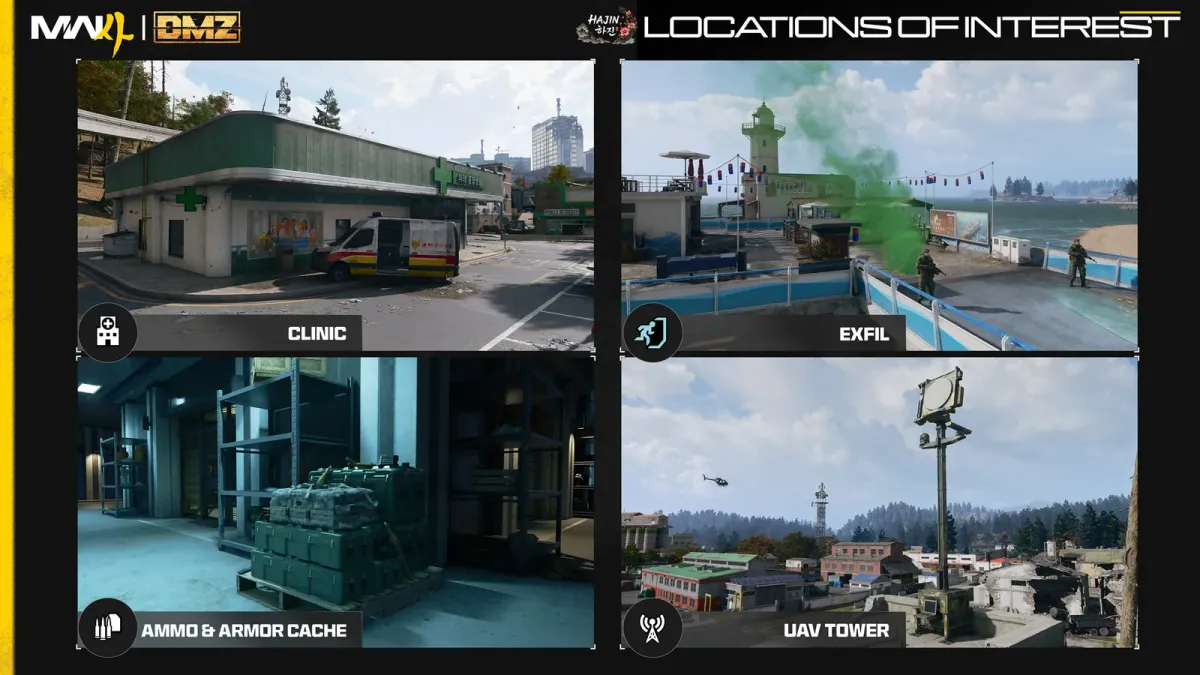
Loot is themed by location
Loot placement is location-themed, which is a massive improvement over random crates. Police Stations hold military gear and a locked Armory that takes the Police Station Armory key. Fire Stations stock Radiation Gear and Parachutes. Clinics have medical loot. Compounds are small fortified military positions with better loot, armored vehicles like the LTV, and heavy resistance if you go in loud. Gas Stations and Marine Gas Stations repair and refuel vehicles and refill your Gas Cans. Ammo and Armor Caches, often inside enemy compounds, refill ammo and plates on a cooldown.
There are also SAM Sites you can capture as a Side Op. Stand at the launcher until the capture bar fills. Activision says a captured site then shoots at enemy aircraft and calls it out as particularly useful against Deathstalkers, and later DMZ Orders ask you to commandeer one and shoot down a cargo chopper with it. UAV Towers work the same way. Activate one for a Side Op payout and a pulse that reveals nearby Operators and enemies. Since the October 22 update you can also steal back a UAV Tower that another squad controls.
Finding Police Stations, Clinics and Other POIs on the Tac Map
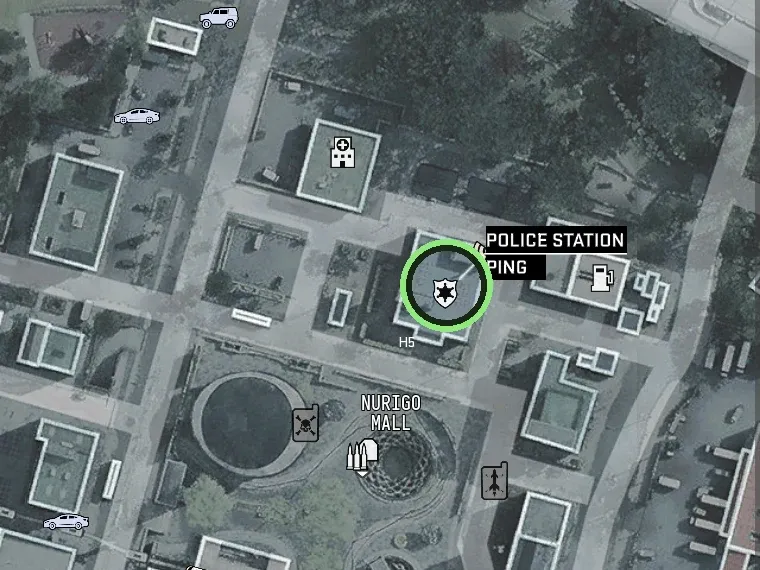
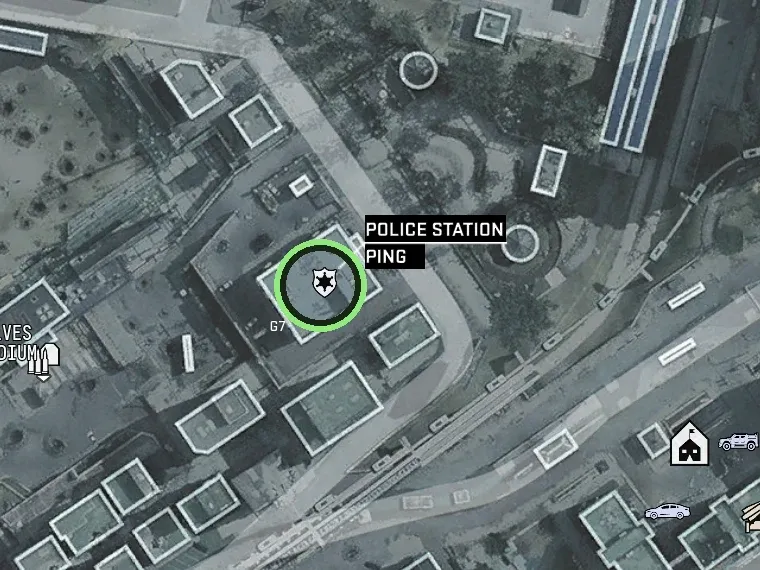
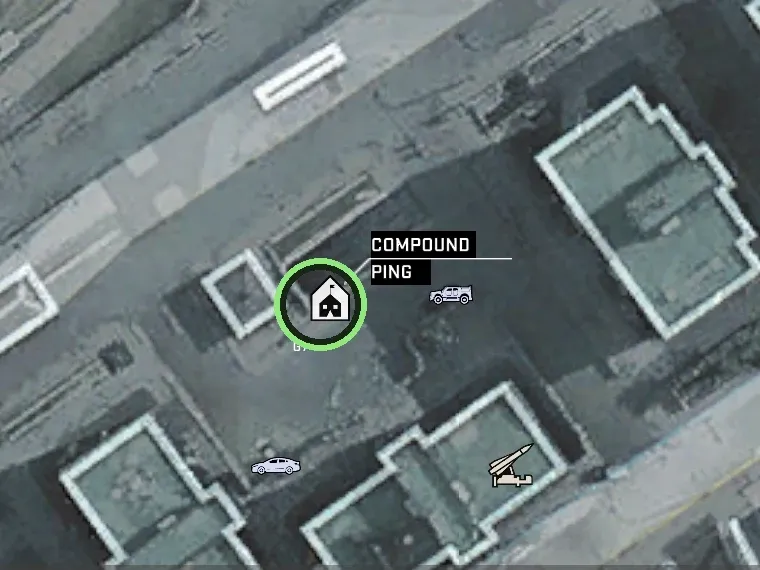
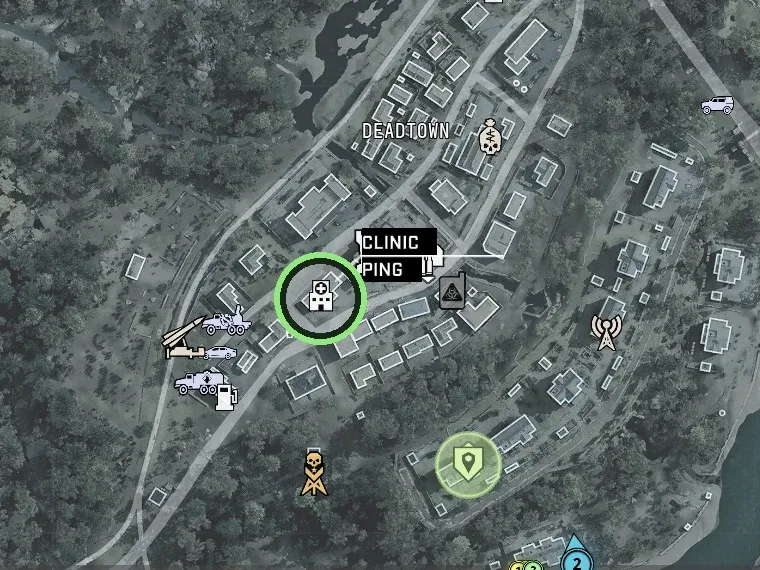
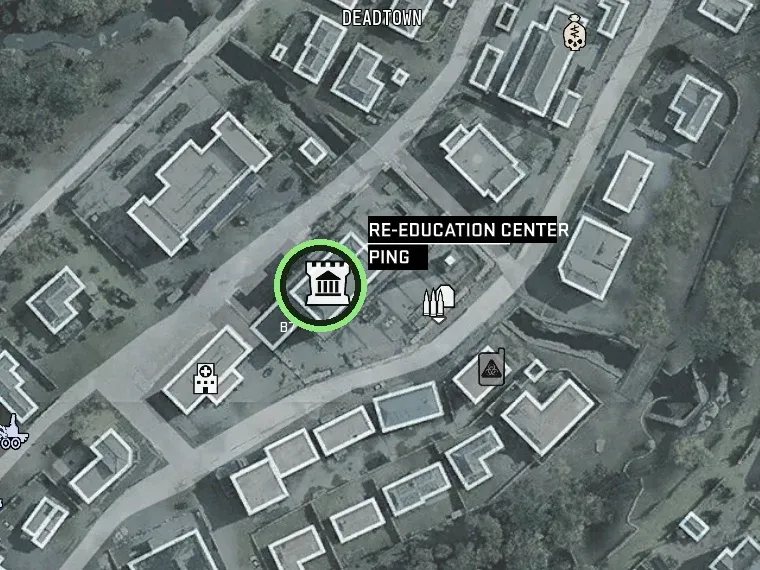
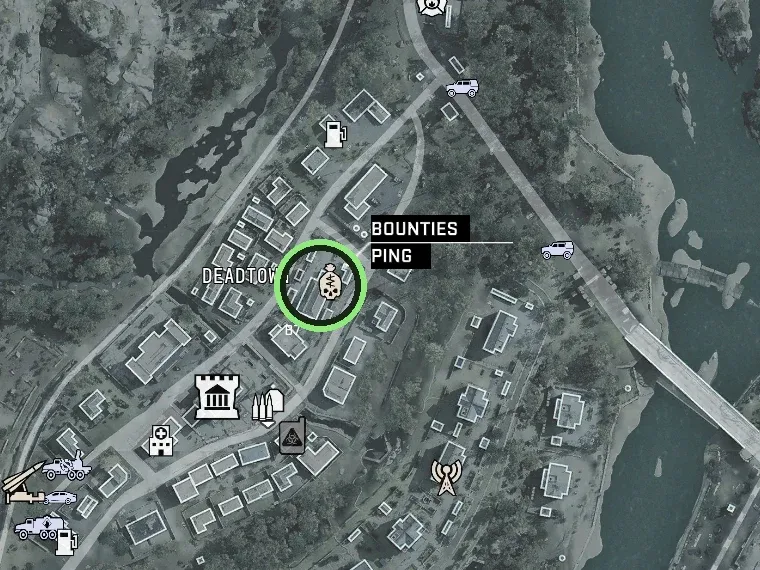
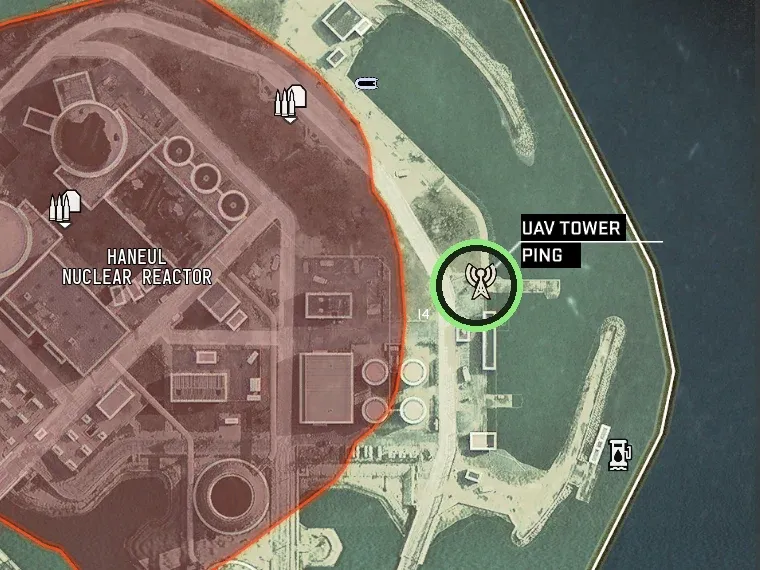
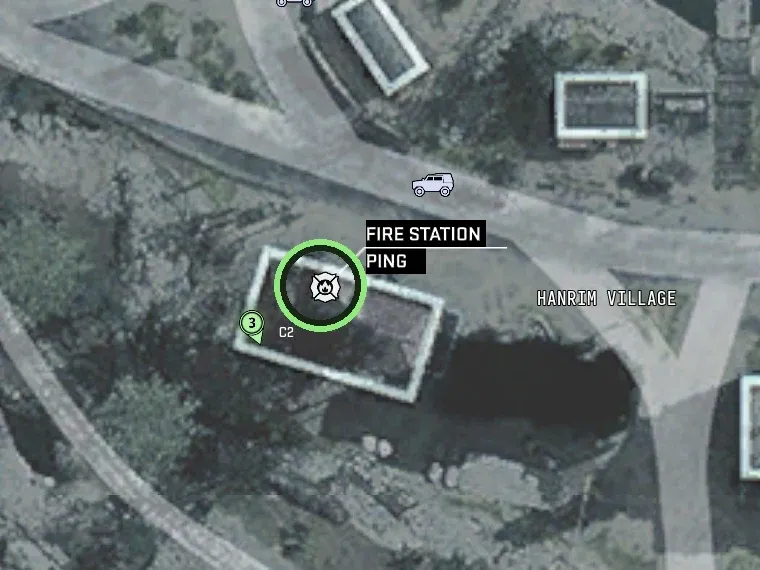
Plenty of DMZ Orders and side ops send you to a type of place rather than a named one, such as a police station or a clinic. These places are marked with small icons on the tac map. A police station is a shield, a clinic a building with a cross, a fire station a fire department badge, a compound a house with a flag, the Re-Education Center a columned building, a UAV Tower a radio mast, a Lieutenant Hunt Tower a tower, a SAM Site a missile launcher and a bounty station a money bag with a skull. Zoom in and ping one, and the game prints the grid square next to the ping. The shots below come from our own tac map, and we also captured a SAM Site next to a gas station in B7.
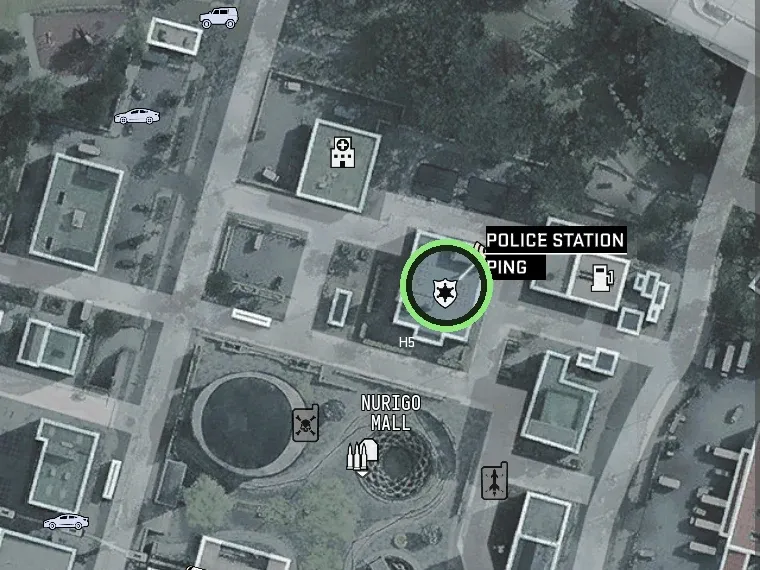 Click to enlarge Police station at H5, next to NuriGO Mall.
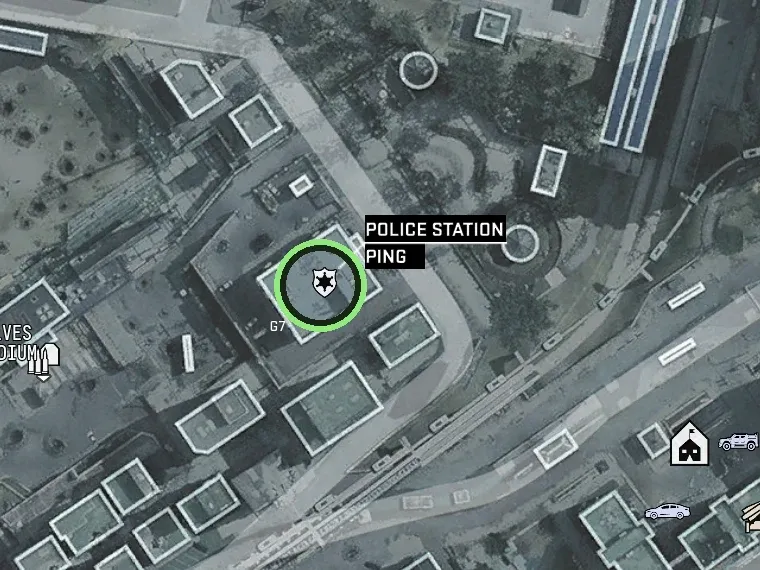 Click to enlarge Police station at G7, by Wolves Stadium.
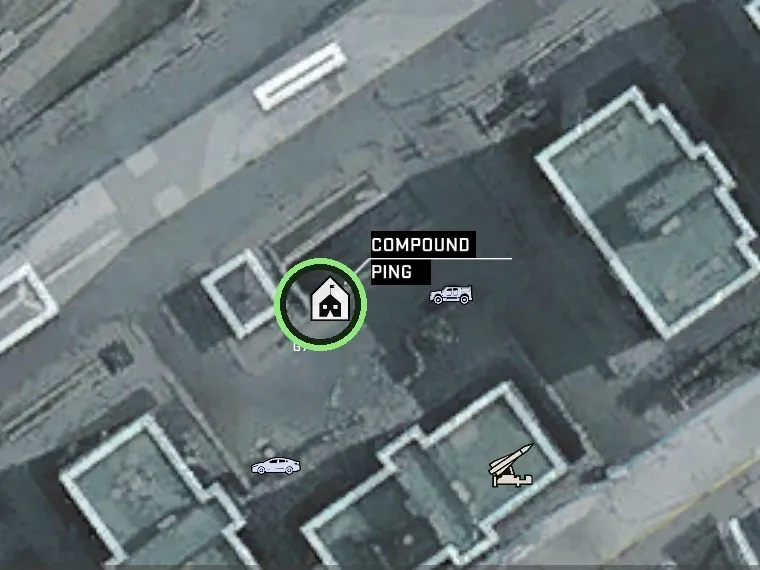 Click to enlarge A compound at G7, by Wolves Stadium.
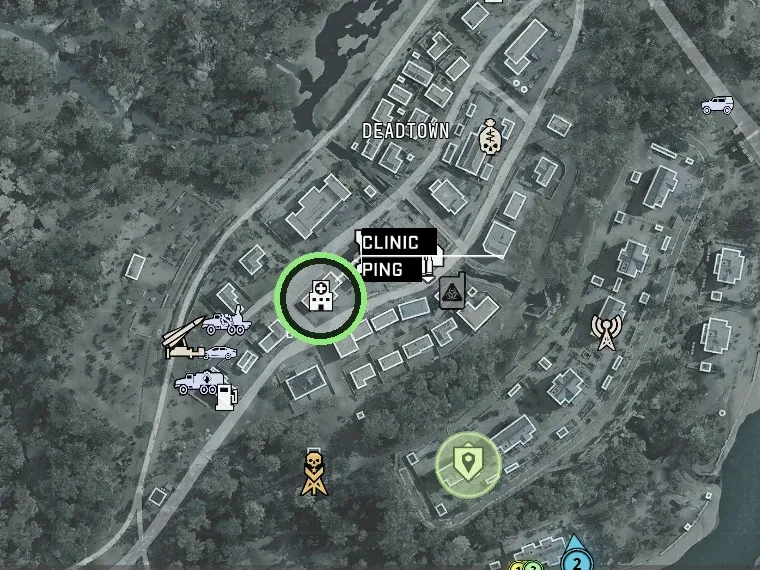 Click to enlarge The clinic in Deadtown, B7.
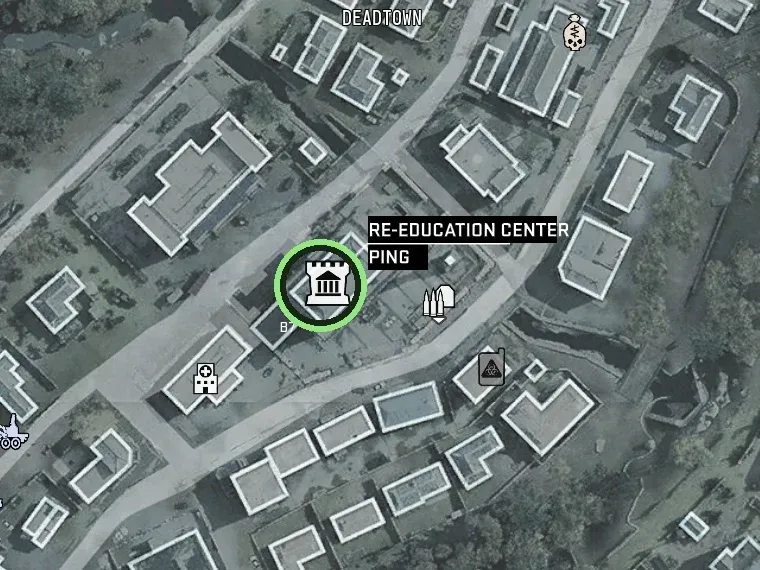 Click to enlarge The Re-Education Center in Deadtown, B7.
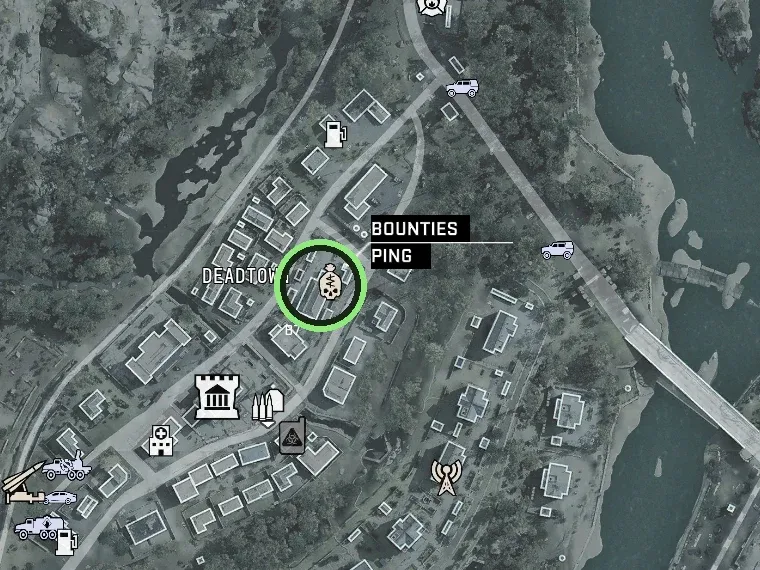 Click to enlarge The bounty station in Deadtown, B7.
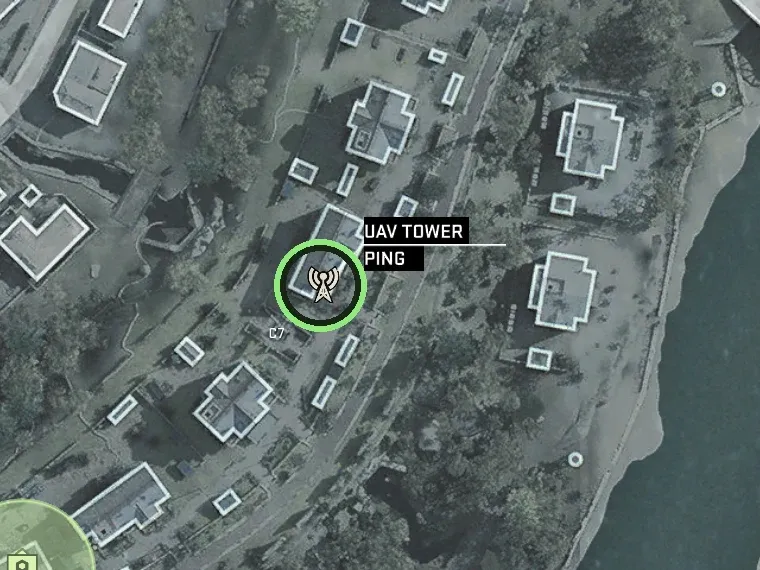 Click to enlarge A UAV tower in Deadtown, C7.
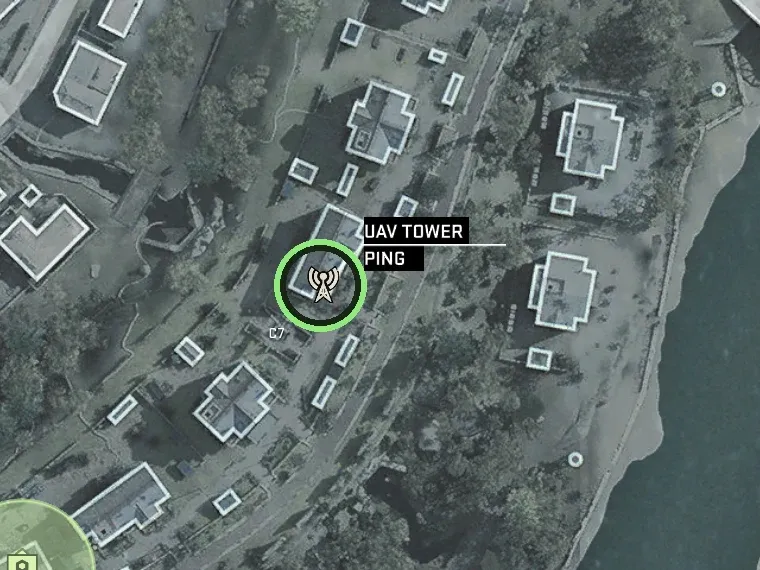
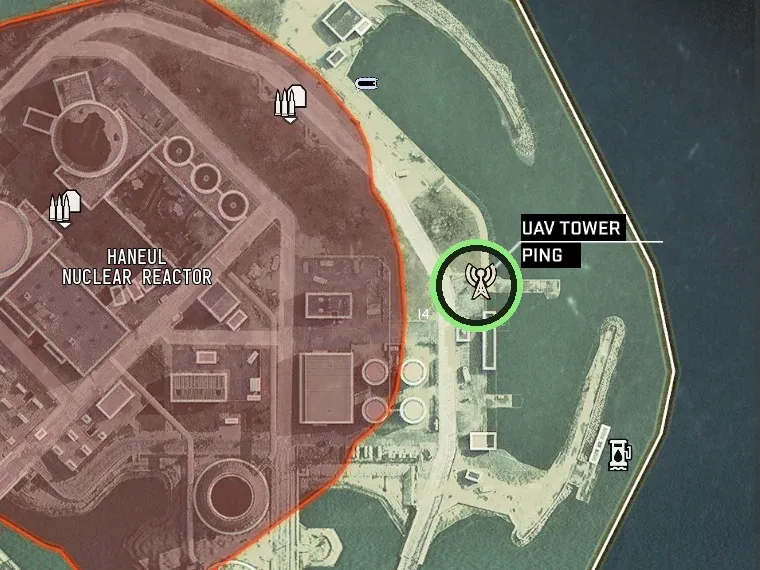 Click to enlarge A UAV tower at the Haneul Nuclear Reactor, I4.
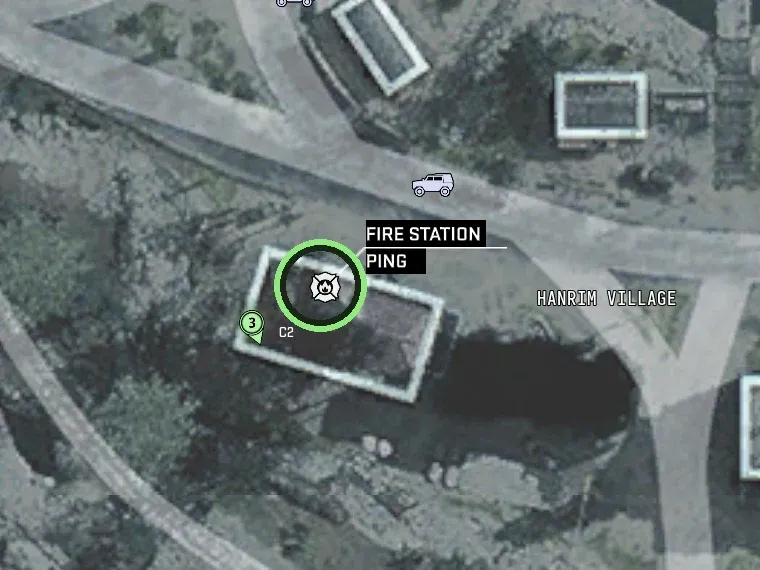 Click to enlarge The fire station in Hanrim Village, C2.
Our interactive map lists every police station, clinic, fire station and compound with its grid, and our DMZ Orders guide shows which order needs which of these places.
Threat Levels and Enemy Types

Every point of interest has its own Threat level, shown under the compass when you enter a new area. The scale runs from Low to Extreme. As you make noise, the threat rises and the enemy response gets more dangerous and more numerous. Human Operators are not counted in the indicator, so a Low area can still hold a squad waiting for you.
The key detail is that it cools off. Break contact, take cover, go stealthy or move to a rural area where enemies lose sight and sound of you, and the threat drops. Activision’s own tip is melee, throwing knives and suppressed shots to move through high-threat areas unnoticed. That is the closest DMZ gets to a retreat button, and it is what makes solo play viable.
The HUD also counts the hostiles you have killed in the current deployment. Activision says a high enough count sends an enemy Hunt Squad after you and marks you for death. We have not triggered one yet, even at 145 kills in a single run.
The enemy roster
Activision’s field guide lists the forces of the secretive North Korean faction holding Hajin. Soldiers come in various ranks with varying gear, and the list ends with a literal [CLASSIFIED] entry.
- Tier 1 North Korean Grunts
- Tier 2 Armored North Korean Soldiers
- Tier 3 Armored, Gas Masked North Korean Soldiers
- Tier 4 Faceless Armored North Korean Soldiers
- Autonomous Combat Drone Swarms and Autonomous LMG Combat Drones
- Autonomous Quadrupeds: K9 robot dogs, usually found underground
- Attack Infantry Helicopter Patrols and Road Convoys
- Bosses: Lieutenants, and three Commander types (Colossus, Deathstalker, main NK Battle Tank)
- Enemy players
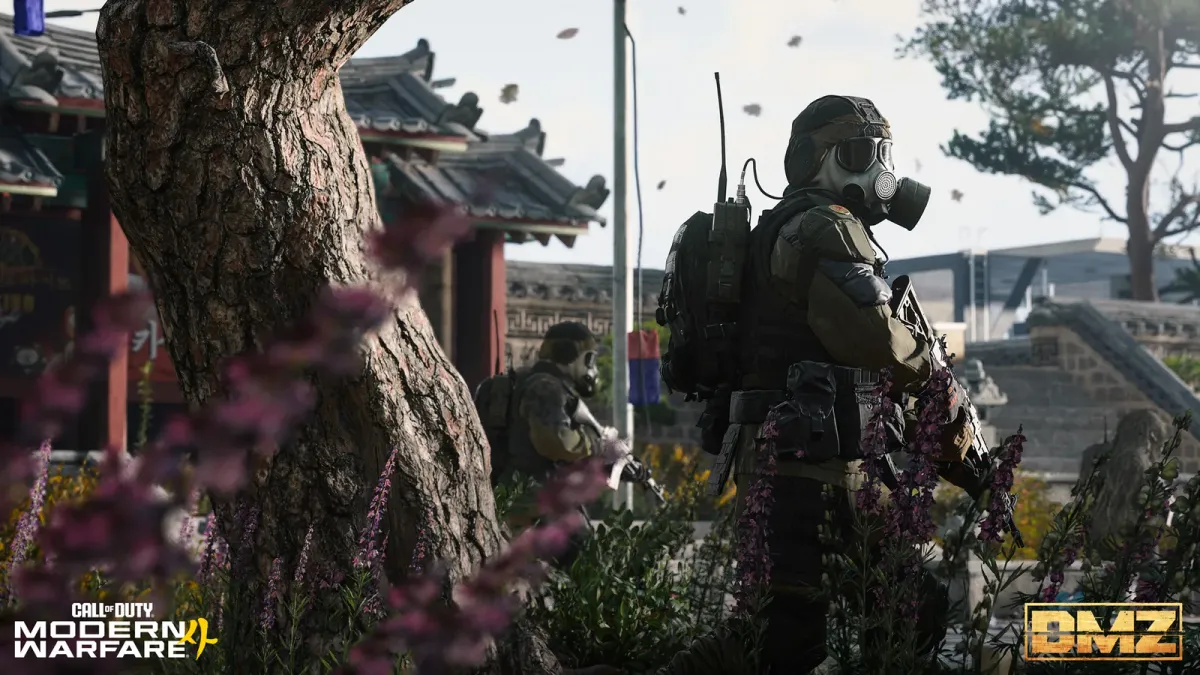
The Deathstalker is not a helicopter. Activision describes it as a helicopter-sized autonomous drone with dual machine-gun turrets, one of four drone types active in Hajin. The seven-foot heavy with the minigun is the Colossus, and its minigun fires depleted uranium rounds.
Stealth Meter
A visual indicator on your HUD tracks how close you are to being detected by AI. It shifts from white to yellow to orange as enemies notice you, then red once they know where you are. Anything below red is still recoverable: go prone or break line of sight and detection resets, which turns a bad approach into an ambush instead of a firefight. Stealth was the biggest part of the original DMZ for us. Fighting AI pulls in players, and a visible warning is exactly what slower, more casual squads needed.
Lieutenants and Commanders

Hajin has two tiers of boss. Lieutenants are named, battle-hardened operatives with a unique loadout and often a small escort, and they may be active whether you are hunting them or not. To find one, climb a Lieutenant Hunt tower and use the terminal at the top to reveal the nearest Lieutenant, or buy intel at the Boss Board in the FOB. Purchased intel is good for one deployment, so make it count.
Killing a Lieutenant pays a substantial chunk of DMZ XP and DMZ Cash, has a rare chance of dropping their iconic weapon, and can drop a Key to their personal locked loot room (check the corpse if the gun does not drop). They always drop their dog tag, such as Kang’s Dog Tag from the Warden. The moment you pick it up your position is broadcast on the Tac-Map for every Operator in the match, so the only sane play is an immediate exfil. Extract with the tag to progress the Boss Board, whether you took it from the Lieutenant or from another player.
Our Boss Board guide has the numbers from our own runs. There are 10 Lieutenants on the board, each worth $10,000 for your first takedown, and intel on one costs $25,000. Some stay locked for intel until you finish DMZ Orders chapters. On our board, Roze needed the Underground chapter, and Gorani and Bale needed Underground, Counterfeit and Human Intel. When we extracted with the Warden’s dog tag, the extraction summary added another $25,000 and 1,000 XP on top of the $10,000.
Commanders are roaming bosses that are always present somewhere in the Exclusion Zone. No intel can be bought for them. They are marked on your Tac-Map when close and your Team Leader warns you over comms. They are described as seemingly impervious to many standard weapons, and in June Infinity Ward compared the fights to MW2’s raids. The payoff is a DMZ Cash reward the first time you kill each specific Commander ($50,000 on the Boss Board), prized 3D Printer Ingredients, a lot of XP and an update to the Boss Board.
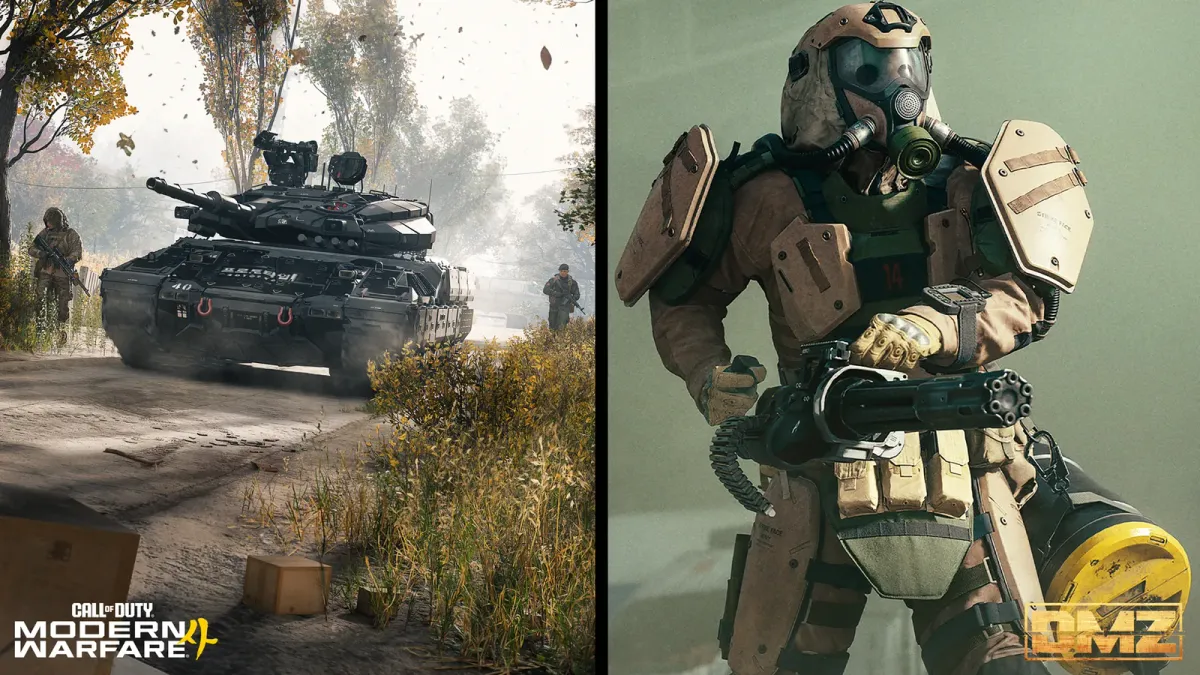
- Colossus, a seven-foot, heavily armored soldier with a minigun firing depleted uranium rounds. We ran into him twice during Operation Iron Citadel, once in the North Korean Wilderness on the way in and once in the bunker garage.
- Deathstalker, a helicopter-sized autonomous drone with dual machine-gun turrets. We met one at NuriGO Mall, and Activision says a captured SAM Site shoots these down for you.
- Tank, a North Korean main battle tank on high alert, patrolling the roads.
HUD and Tac-Map
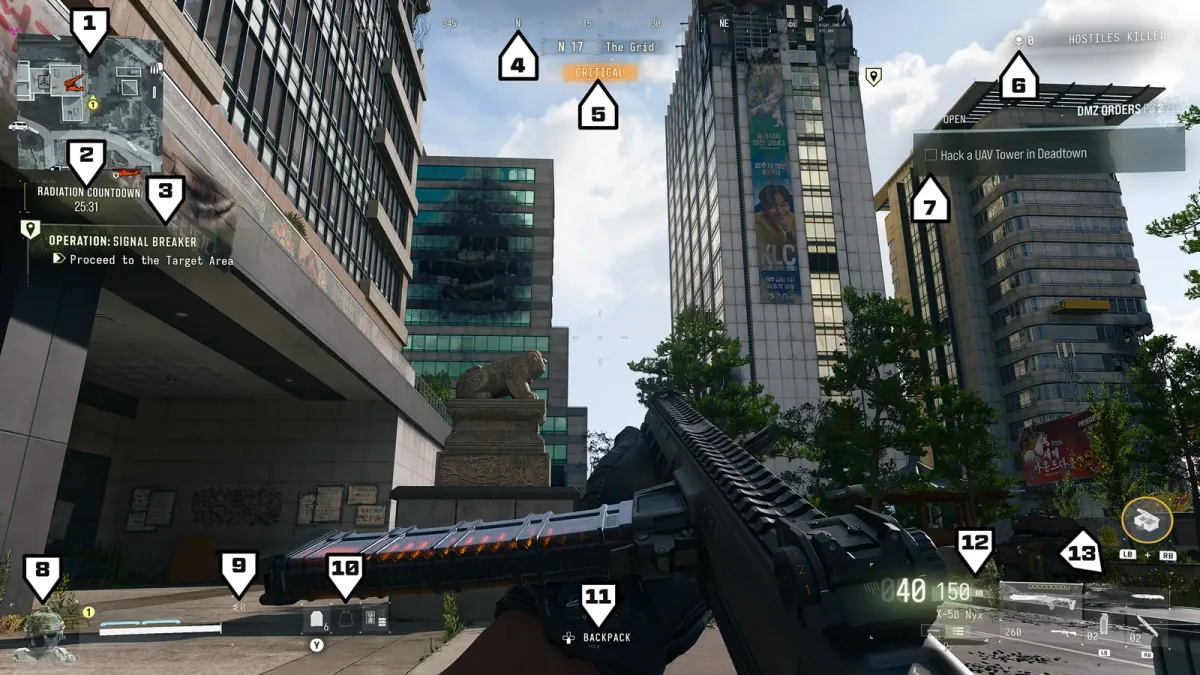
Several HUD elements differ from Multiplayer. The ones that change how you play:
- Threat Level under the compass, for the POI you are standing in.
- Hostiles killed, a counter for the current deployment. Activision says a high count summons a Hunt Squad, which we have not seen yet.
- Radiation Countdown, roughly 30 minutes at the start of a deployment, followed by a Radiation Spreading timer once it runs out.
- Squad HUD showing each Operator’s health, plates, downed or wounded state, DMZ Cash carried, and equipped Gas Mask and Parachute.
- Weapon display with rarity and equipped attachments, because looted guns can carry up to eight attachment slots.
- Backpack menu for swapping Tacticals and Lethals, using Bandages or extra plates, and switching Field Upgrade boxes mid-match.
- Ping Wheel for silent squad comms, requesting a Truce, or assimilating with another squad when voice is unavailable or best kept quiet.
The Tac-Map shows missions, POIs, threat areas, enemy Compounds, colour-coded key buildings, Ammo and Armor Caches, the spreading radiation and pings. It also carries the grid overlay and the DMZ Orders page.
Vehicles
Everything with an engine has finite armor and fuel, and unlike Warzone, DMZ vehicles need repairing and refuelling at Gas Stations. Certain Traits improve your driving, including fixing a blown tire on the spot.
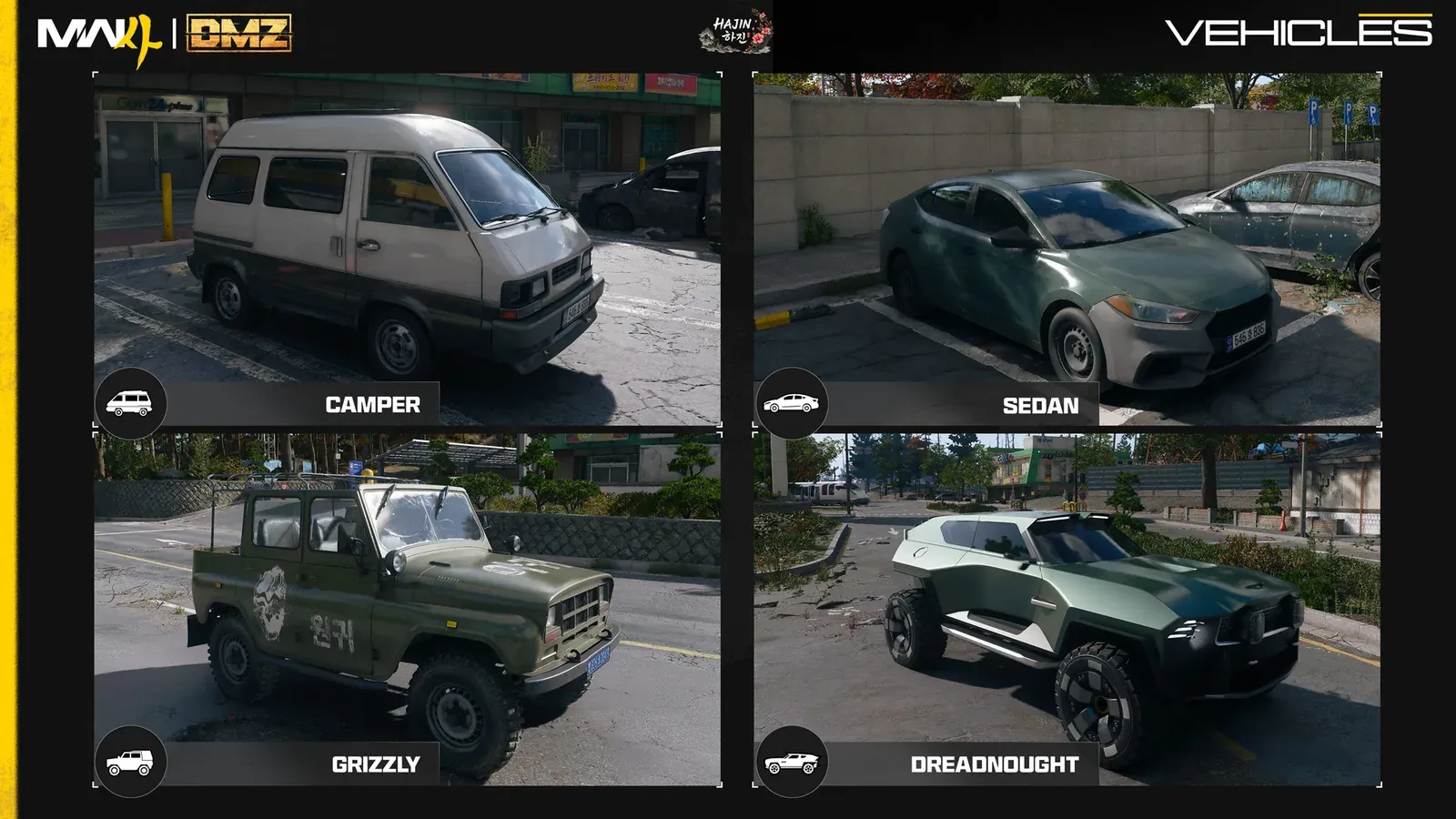
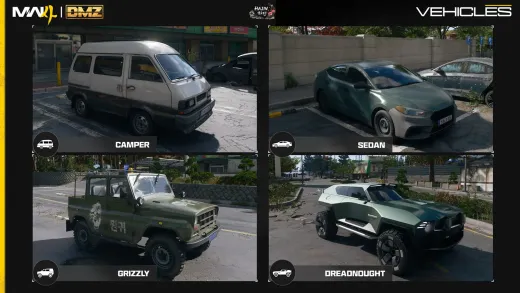 Click to enlarge Camper, Sedan, Grizzly, Dreadnought
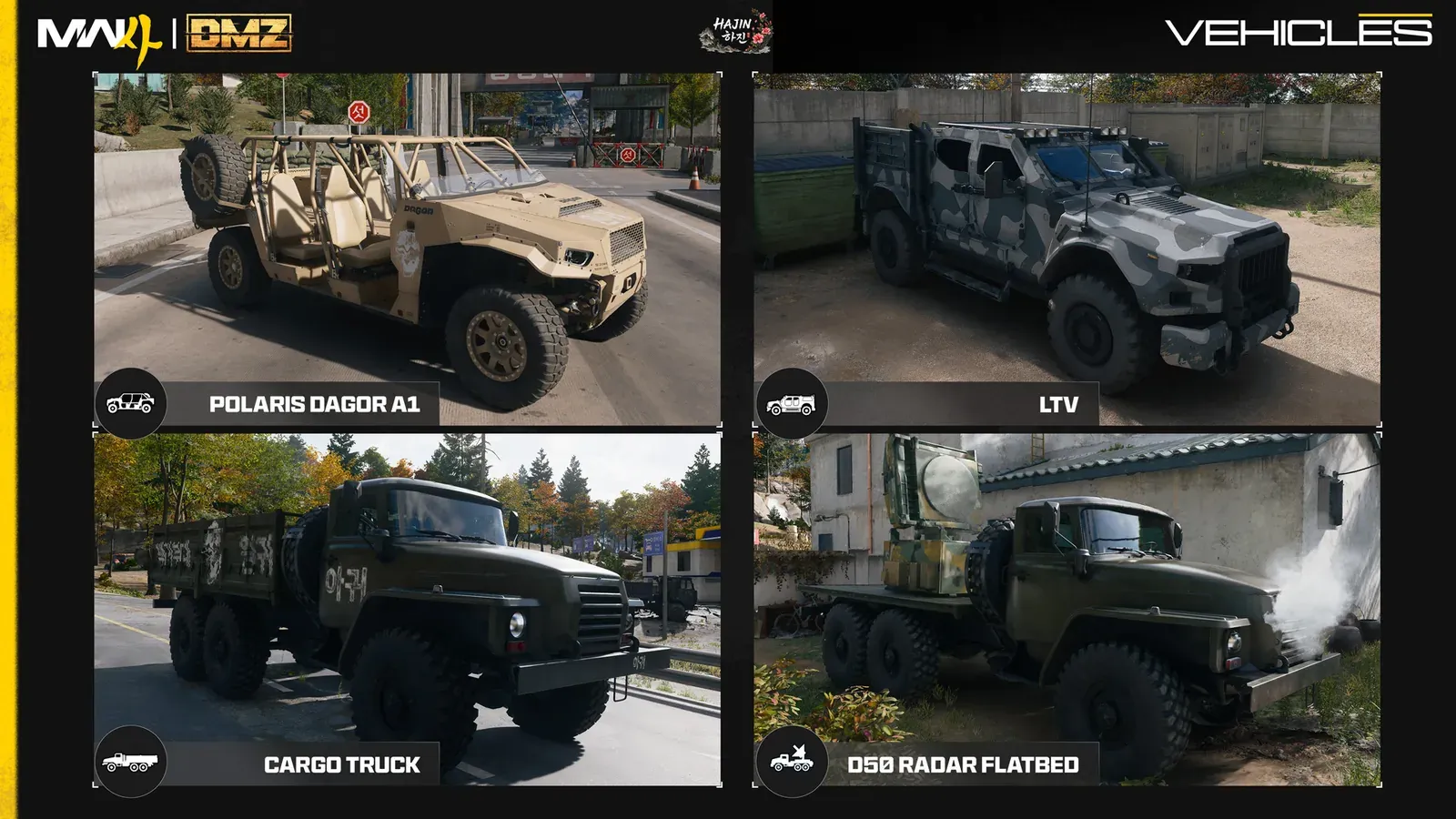
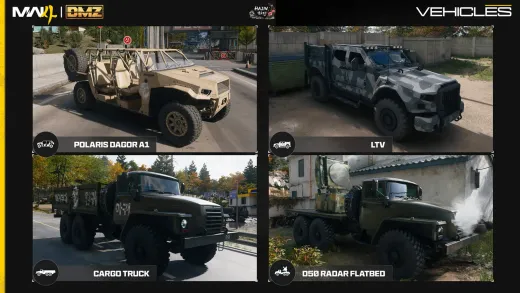 Click to enlarge Dagor A1, LTV, Cargo Truck, D50 Radar Flatbed
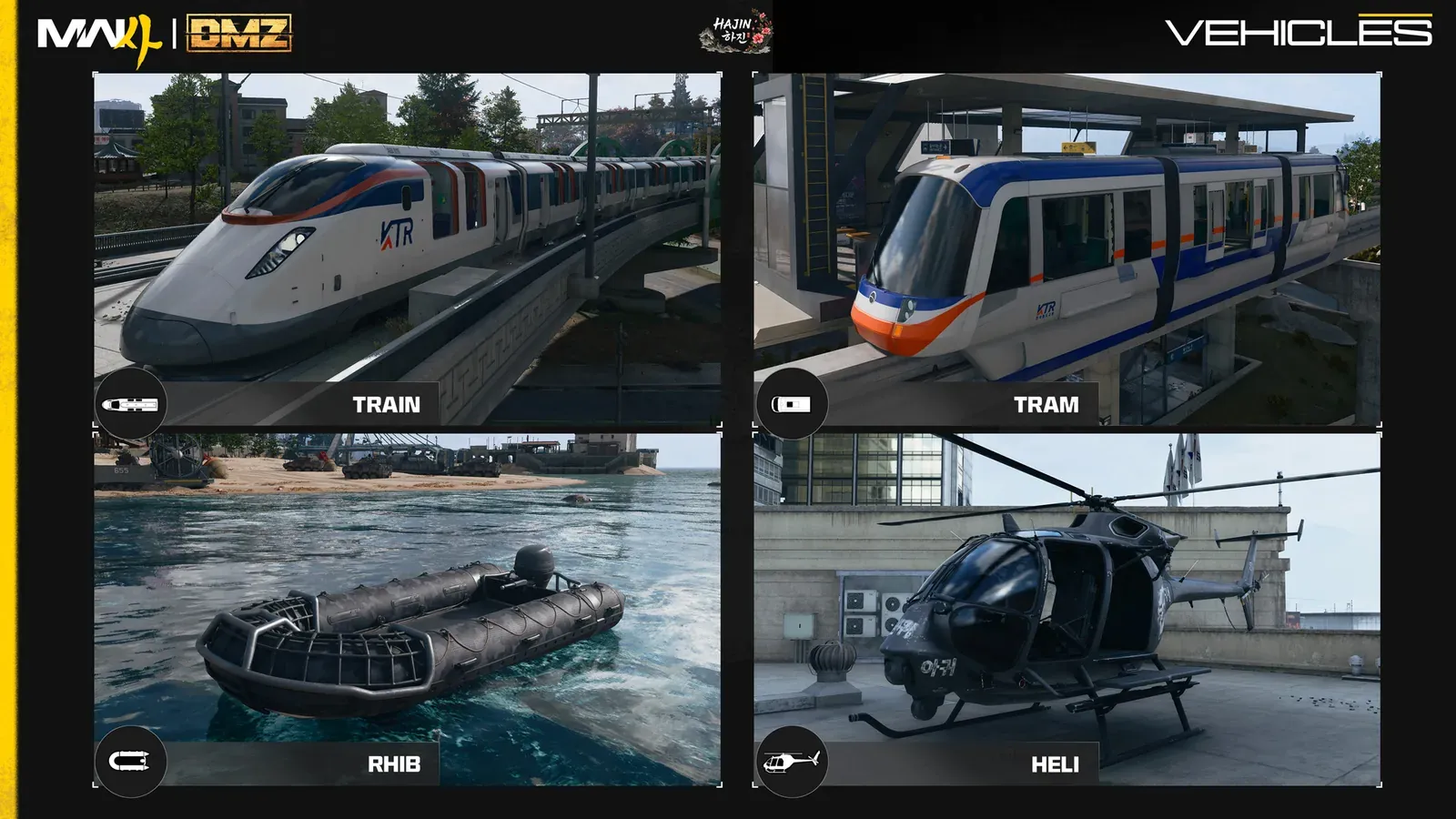
 Click to enlarge Train, Tram, RHIB, Heli
| Vehicle | What it is |
|---|---|
| Camper, Sedan | Unarmed civilian runabouts. Mobility only. |
| Grizzly | Rugged Soviet-design 4x4, light armor, quick and agile. |
| Dreadnought | The Aston Martin armored AWD SUV. Advanced armor, off-road capable, fast. |
| Polaris Dagor A1 | Light tactical vehicle that carries a full squad and their gear. |
| LTV | Heavily armored light combat platform with an optional mounted .50 cal. |
| Cargo Truck, D50 Radar Flatbed | Diesel modular platforms. The D50 carries a vehicle-mounted UAV. |
| Train, Tram | Automated and not player-controlled. The train crosses the SK POIs, the monorail tram loops Hajin City. |
| RHIB | High-speed special operations inflatable. Refuel at Marine Gas Stations. |
| Heli | Twin-engine combat helicopter for transport and fire support. |
| Heavy Chopper, Monarch | Armored troop transport with flares, and the twin-rotor infil/exfil helicopter. Neither is normally player-controlled. |
Extraction and Recovery

Getting out of Hajin is the whole point. Exfil sites come from a pool of locations and are marked by green smoke. Call in the Twin Heli, hold the site while enemy pressure builds, and board. You can also leave by Fulton balloon or flare, and the Fulton Drop Marker showed up at our Vendor for $50,000. Activision warns that exfil flares are extremely loud, visible from a long way off, and rival squads use exfil sites as ambush points. The exfil helicopter is a massive twin-rotor machine with multiple entry points, and explosives knock players back instead of dealing pure damage, so you can literally be knocked out of it mid-extraction.
Not every deployment ends in success. When things go wrong, you have options:
- A Tourniquet gets you up from Last Stand into a wounded state without a self-revive. A Medkit repairs the wound to full health. Melee attacks can interrupt either.
- Teammates can physically drag each other to safety, and the First Look trailer showed a revive mid-drag. You can also grab downed enemies to stop their team rescuing them.
- Upgraded Backpacks have Secure Slots whose contents survive a failed exfil.
- For an MIA Operator you pay DMZ Cash at the Operators station to bring them back with their Traits, unspent Trait Points and Dog Tag rank. Or dismiss them and recruit a new one.
Self-revives have their own Loadout slot, so they are still the clean option when you find one. After you fully die you can still spectate your teammates, as we found in our own runs.
We have not found a way to plea. Creators who saw the mode before launch reported that fully dead players can no longer plead to a rival squad for a pickup, and neither October guide mentions pleas at all. What the guides do confirm is that the Ping Wheel lets you request a Truce or assimilate with another squad, so joining forces survives even if begging for a lift does not.
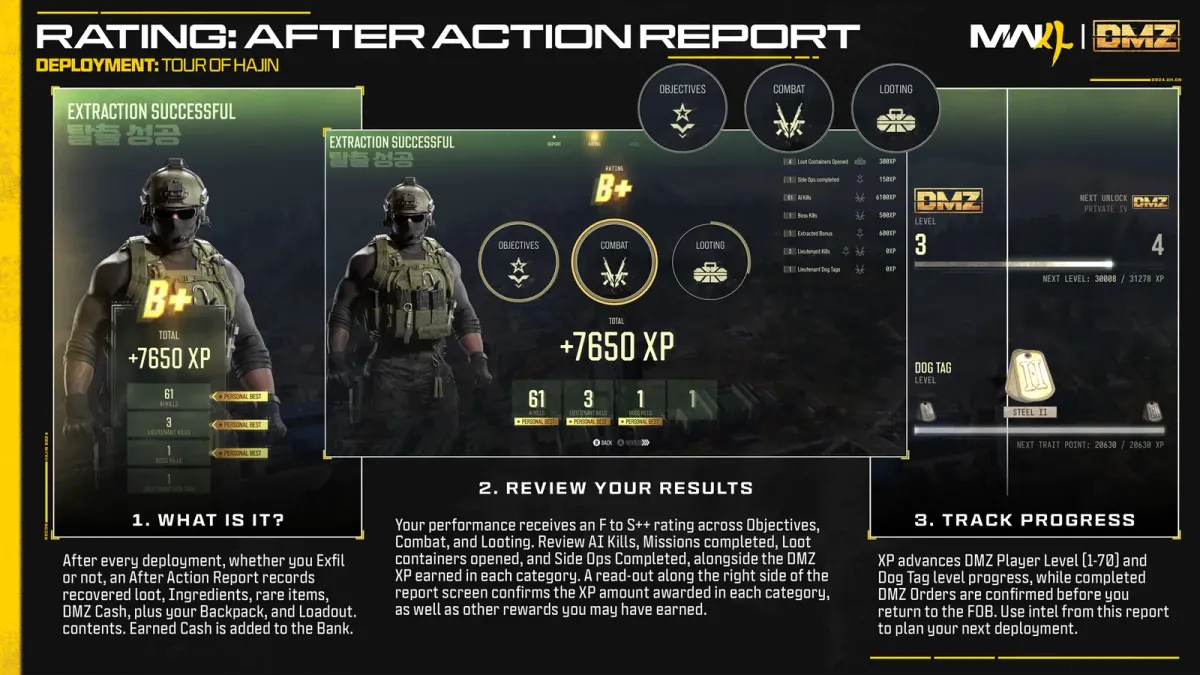
Every deployment, successful or not, ends with an After Action Report in four parts: a loot and cash Report (cash goes into your Bank), a Rating from F to S++ based on Objectives, Combat and Looting with totals for AI kills, missions, containers and Side Ops, your DMZ Level and Dog Tag progress, and a Summary of completed Orders and rewards. There are no forced wipes. Infinity Ward ruled out Tarkov-style resets as too hardcore for a CoD audience, and Operator Prestige is meant to be the voluntary fresh-start system.
PvP and the Bounty System

Other players are in every match. The extraction shooter tension of not knowing if that squad around the corner is friendly or hostile is core to the experience, and MW4 DMZ leans into it with a bounty system that tracks you across deployments, not just within one match.
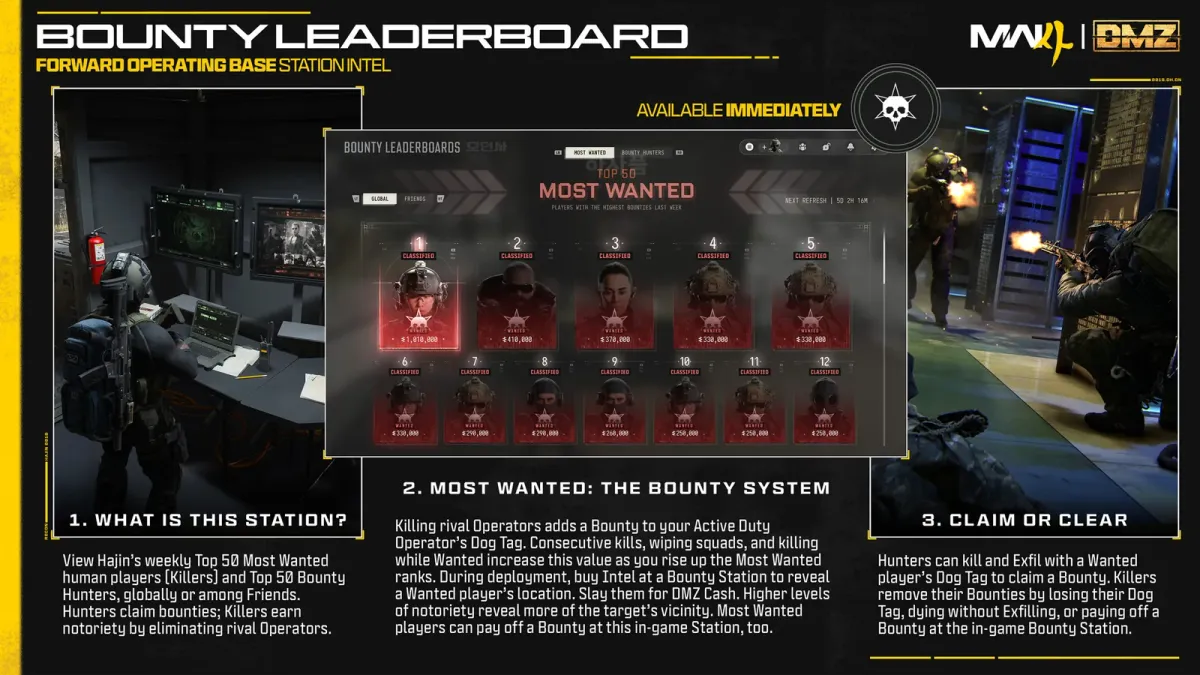
Here is how Activision describes it. Kill a rival Operator and you immediately earn a Bounty, listed on your own Dog Tag along with your Operator kill count. Keep killing and the Bounty climbs through several Wanted states. At four kills you are officially Wanted, and from then on nearby Operators are automatically alerted when you come close. The biggest Bounties are Most Wanted and get displayed on the FOB leaderboard. Activision says the system tracks who fired first and whether you were outnumbered, so self-defence does not count the same as hunting.
Hunters go to a Bounty Station in Hajin, see the list of Wanted Operators in the current deployment for free, and can pay DMZ Cash for intel that draws a circle around a target’s general area. The circle shrinks and updates faster the more Wanted the target is, and at the highest level the target’s vicinity is probably visible to everyone in the match without paying. To claim the Bounty you kill the target and extract with their Dog Tag. When we checked the bounty station in Deadtown early in Early Access, nobody was on the list. On October 23 a bounty station showed one Wanted player with a $50,000 bounty, and intel that reveals their position on the tac map cost $12,500.
The FOB’s Bounty Leaderboards show the Top 50 Most Wanted, the players with the highest bounties of the past week, next to a Bounty Hunters board. It refreshes once a week, with a countdown on screen. When we checked on October 24, the top bounty was $420,000, and even 12th place carried $330,000. A player who has been eliminated stays on the board, crossed out.
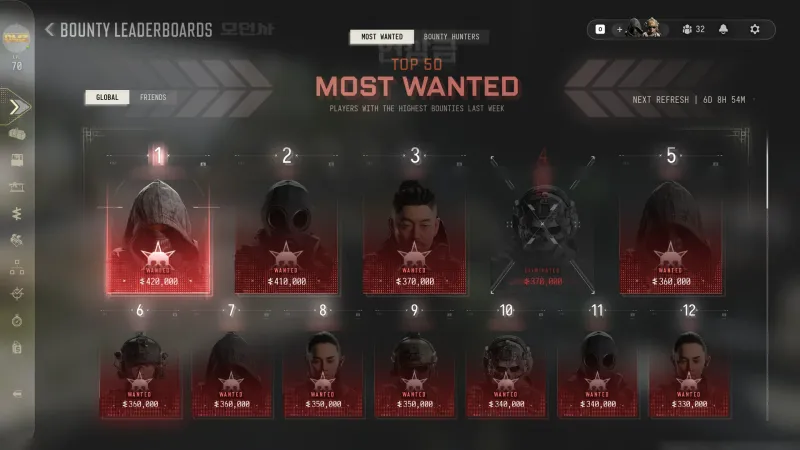 Click to enlarge The Top 50 Most Wanted board, with player names blurred.
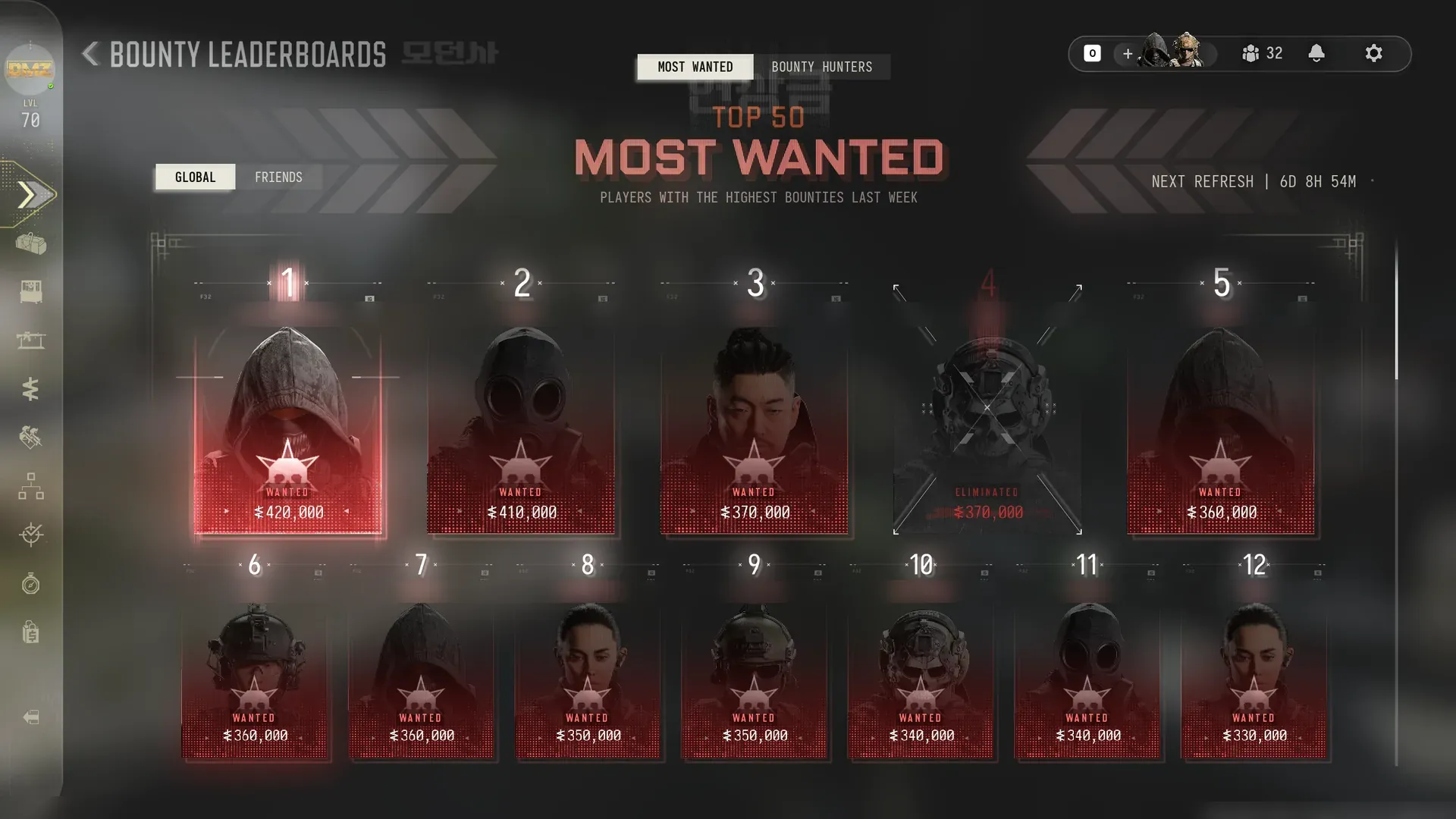
Losing a Bounty happens three ways: you die and fail to exfil, another player takes your Dog Tag and extracts with it, or you pay it off yourself at a Bounty Station. Dog Tags also level with your Operator, so a Damascus or Onyx tag in someone’s Dog Tag Case is a trophy with a story on it: victim, killer and time of death.
This is the part of the new design we feel strongest about. It makes you think about how you fight. Wiping a team could mean being hunted for the rest of the week, so you play more deliberately, and casual squads who just want to run missions get real protection they never had in the original. We once spent a whole match re-enacting a police chase, chasing another team around in an armored LTV over game chat, and those interactions are what make DMZ special. The larger map was designed to “push players apart better” according to Joe Cecot, and the bounty system gives that space teeth.
Proximity Chat
Proximity chat was one of the best parts of the original DMZ, and MW4 upgrades it significantly:
- Distance-based vocal falloff, so enemy voices get louder as they approach
- Directional audio, so you can pinpoint which direction someone is talking from
- Environmental reverb, where interiors and terrain affect how voices echo and give away enemy positions
Activision calls proximity chat the fastest way to talk to nearby Operators, with the Ping Wheel as the silent alternative for a Truce or an assimilation request. The First Look trailer also showed first-person finishing moves on downed enemies, so expect proximity chat to get personal.
Between Runs: The Forward Operating Base (FOB)
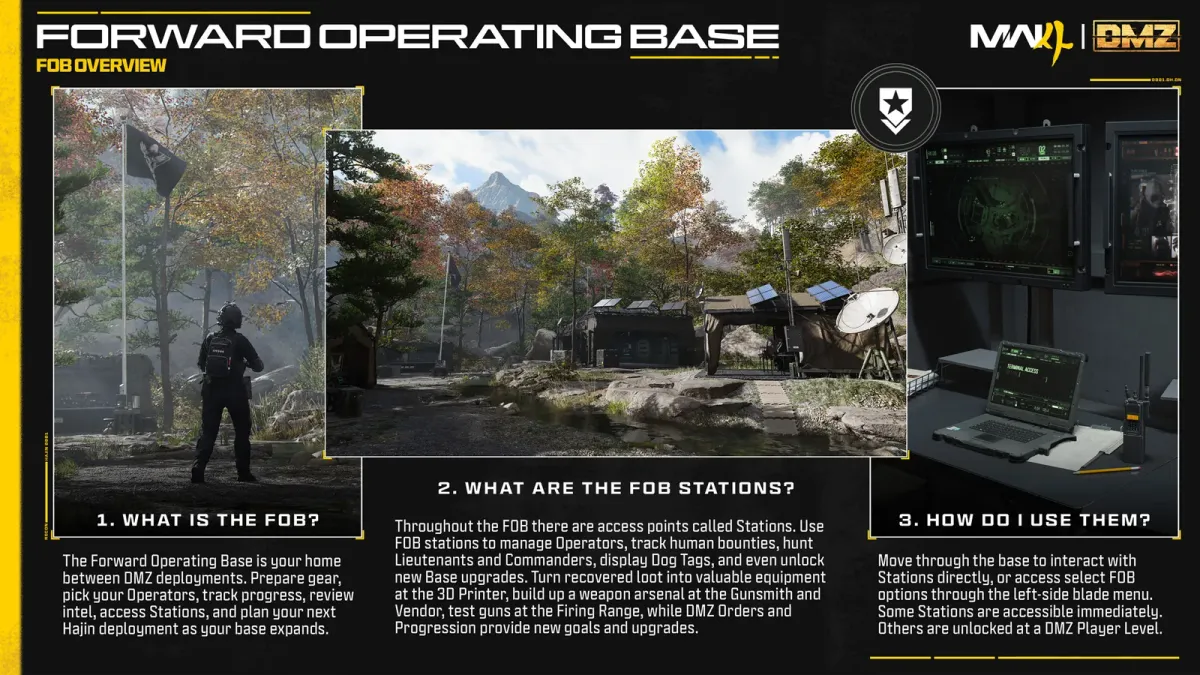
The FOB is your persistent home between deployments. You offload loot, gear up, take your next Orders and manage your Operators there, and it grows as you level up. You start with the Stash, Operators, DMZ Orders, Survival Kits, the Firing Range and Deploy. The 3D Printer unlocks at DMZ level 2, the Vendor at 5, the Gunsmith at 10 and the Dog Tag Case at 20, and the Boss Board opens through DMZ Orders.
Every station, the station upgrades you get from DMZ levels, the Vendor stock, Survival Kits, MIA rescue costs and Operator Prestige are covered in our MW4 DMZ FOB guide. For the exact DMZ level and XP behind every unlock, see our MW4 DMZ level rewards list from 2 to 70.
Crafting and Looting
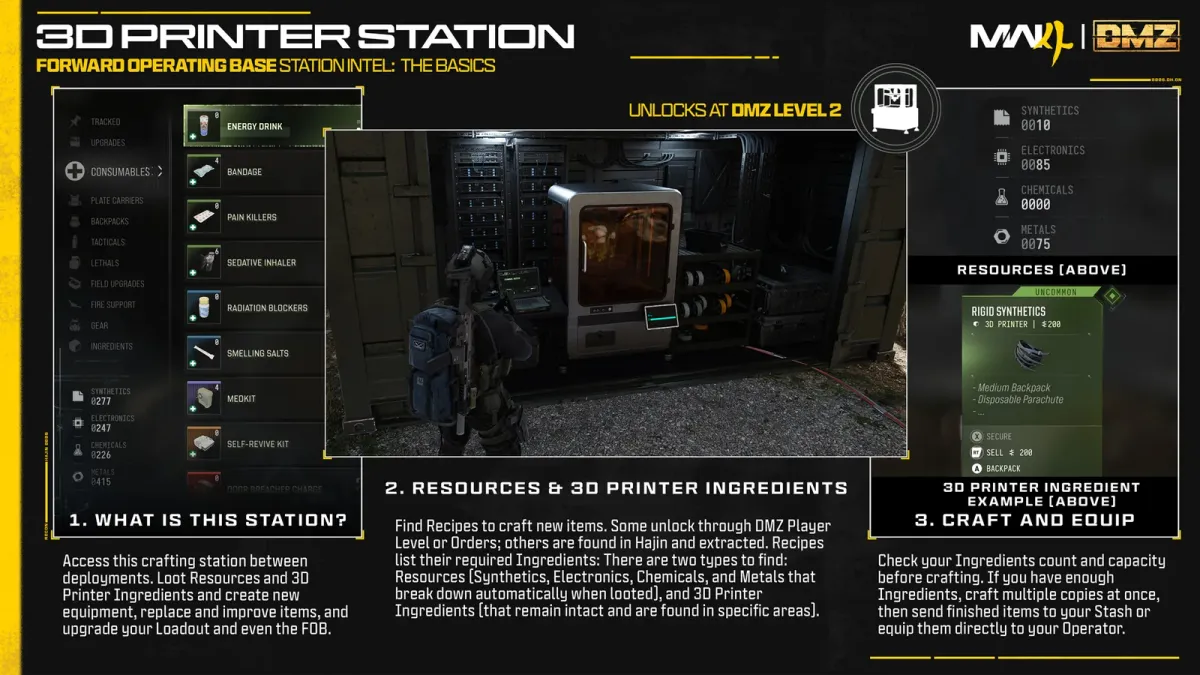
Crafting runs on three things. Recipes are mostly locked at the start and unlock through your DMZ level, DMZ Orders, or by looting a Recipe in Hajin and extracting with it, which also pays 5,000 DMZ Cash. Resources are the four basic materials (Synthetics, Electronics, Chemicals, Metals): everything you loot breaks down into them automatically, they sit in a dedicated pouch on every backpack and they never take up Stash slots. 3D Printer Ingredients such as Binding Catalyst, Biomaterials, Detonators and Control Units are found in specific areas and extracted intact.
The printer shows how much of each ingredient you own, turns green when you can afford an item, lets you craft multiple copies at once, sends output to your Stash or straight onto your Operator, and lets you pin Recipes and Ingredients so they show a tracking icon when you loot them in the field. If you do not know where an Ingredient drops, the printer gives a location hint, and our ingredient locations guide collects those hints along with the places we actually found each one.
Your first recipes at Level 2
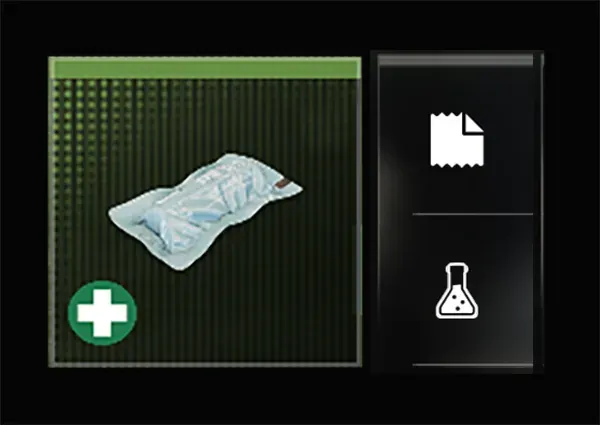
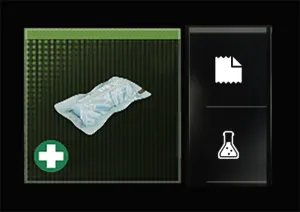 Click to enlarge Bandage: 15 Synthetics, 15 Chemicals
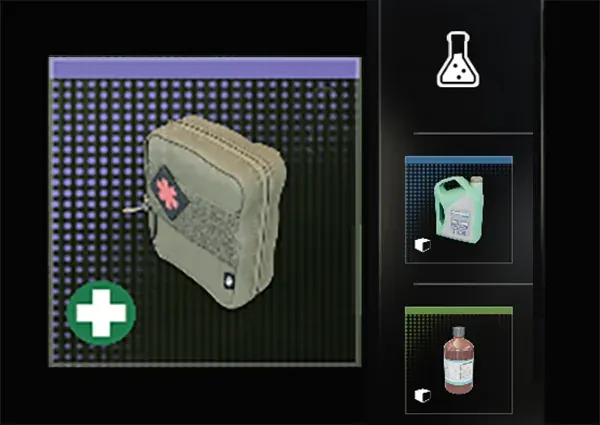
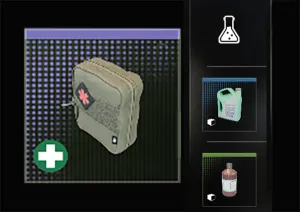 Click to enlarge Medkit: 30 Chemicals, 1 Binding Catalyst, 5 Biomaterials
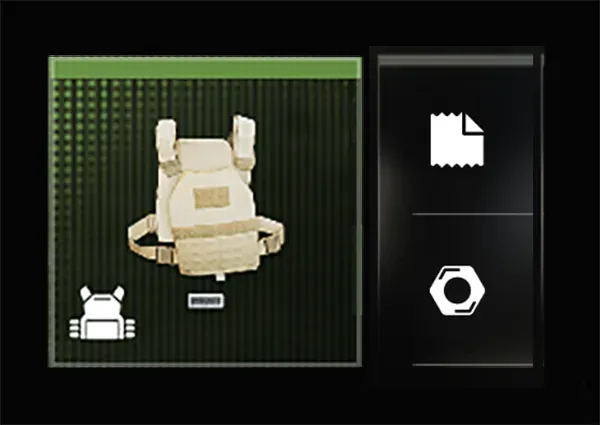
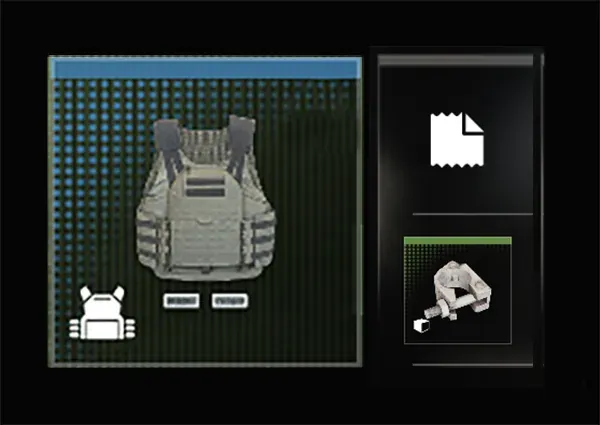
 Click to enlarge 1-Plate Armor Vest: 25 Synthetics, 25 Metals
 Click to enlarge 2-Plate Armor Vest: 50 Synthetics, 5 Reactive Metals
 Click to enlarge Small Backpack: 25 Synthetics, 25 Metals
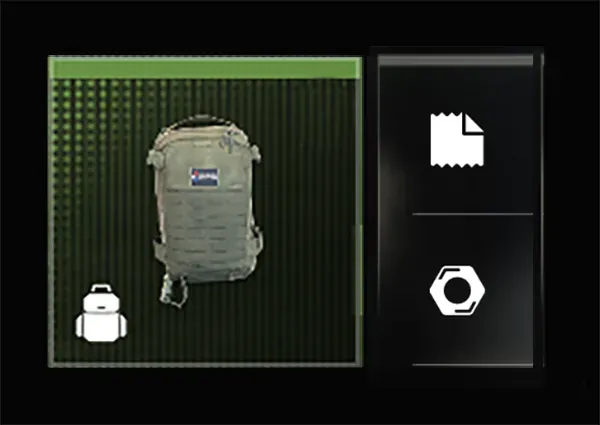
 Click to enlarge Medium Backpack: 50 Synthetics, 5 Rigid Synthetics
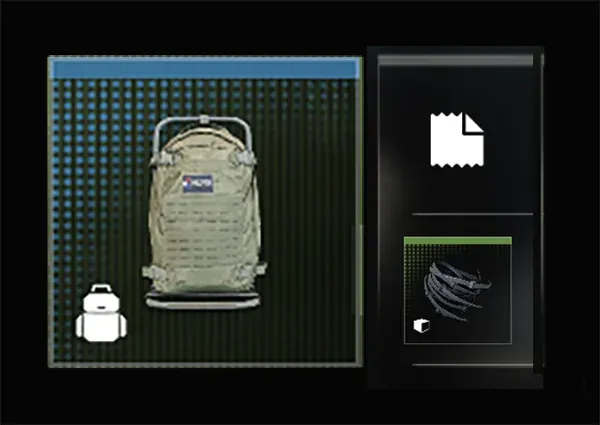
The Medkit matters more than it looks: it repairs wounds to full health and lets you use the tourniquet to get back on your feet from Last Stand. The Medium Backpack is the first one with Secure Slots, which keep an item even if you fail to exfil.
What the printer can build
The categories are Consumables, Plate Carriers, Backpacks, Tacticals, Lethals, Field Upgrades, Fire Support (Killstreaks), Gear (gas masks, NVGs, parachutes), Ingredients (craft what you previously had to loot) and Upgrades. Field Upgrades do not recharge in DMZ the way they do in Multiplayer. Some Plate Carriers add plate capacity, resist one-shots or use enhanced plates, and some Backpacks add weapon slots or Secure Slots. The Upgrades are permanent FOB improvements, such as more Bank and Stash capacity, MIA Recovery Discounts, Gunsmith discounts and extra Vendor options, and our FOB guide lists them with their costs. Valuables, the loot marked with a gem icon, sell for DMZ Cash but also go into some of these upgrades, so check a recipe before you sell them.
Crafting is the change we wanted most. Finding loot only in certain crates or areas got stale fast in the original, and being able to craft what you need makes challenges and progression far simpler. Not everything is printed at home either: some recipes can only be crafted at a 3D Printer you find inside Hajin, and the Scout tree’s Field Crafting Trait lets you craft from Common resources while deployed.
Since early access opened we have captured 107 printer cards in game. Our MW4 DMZ 3D Printer recipes guide lists every printer card we captured, with exact ingredients, rarity and how each one unlocks.
Operators, Traits and Prestige
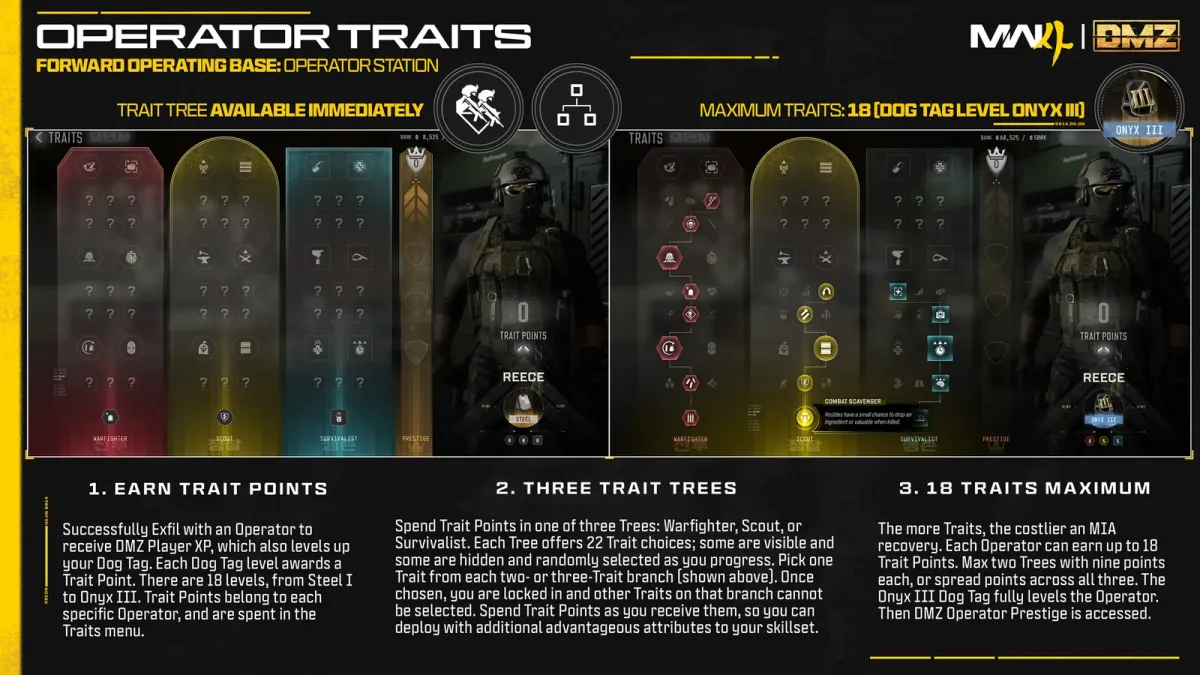
Operators in DMZ are persistent characters. You start with two Active Duty slots (three with the Vault Edition) and unlock another through DMZ levels. An Operator is locked to its slot until you dismiss them, and you cannot run the same Operator in two slots. Skins are free to swap.
Progression runs on three layers:
- DMZ Player Level (1 to 70): earned from every deployment, even failed ones. Unlocks FOB stations, upgrades, Recipes, Operators and skins, Survival Kits and Killstreaks. DMZ XP also feeds your overall 1 to 55 player level, but Multiplayer and Warzone XP do not feed DMZ.
- Operator Dog Tag (18 levels): Steel, Bronze, Silver, Gold, Damascus and Onyx, each in three tiers. Every Dog Tag level-up gives one Trait Point.
- Trait Points: spent in the Warfighter, Scout or Survivalist tree. 66 Traits exist, 22 per tree: six Major Traits that are always visible, and 16 Minor Traits that are randomized and only appear once you unlock the Major below them. Each branch lets you take one pick, picks are locked once made, and with 18 points you can max two trees or spread across all three. In-game, each tree opens with one starting trait that differs per Operator (on our first Operator Free Prep in Warfighter, Resource Pockets in Scout and Rad Blocker in Survivalist), and the next row stays hidden until you buy one. Our MW4 DMZ traits guide lists every trait per tree, with our best builds.
Activision published example Traits, and they show what each tree is for. Warfighter is about fighting (Possum gives you a once-per-match self-revive into Last Stand), Scout is about looting and cash (Investor extracts more cash, Field Crafting lets you craft in the field), and Survivalist keeps you alive (Free Revive repairs your first Wound automatically, and Die Hard calls the exfil for you when you reach it in Last Stand). Our traits guide has every trait with its effect.
We said in June that we would run multiple Operators for stealth, medic and combat builds, and the trees are built for exactly that. Loot cannot be shared between teammates and each Operator’s inventory is individual, but DMZ Cash, Resources and Ingredients are shared across all your own Operators, so a Scout-specced looter can feed your Warfighter.
Operator Prestige
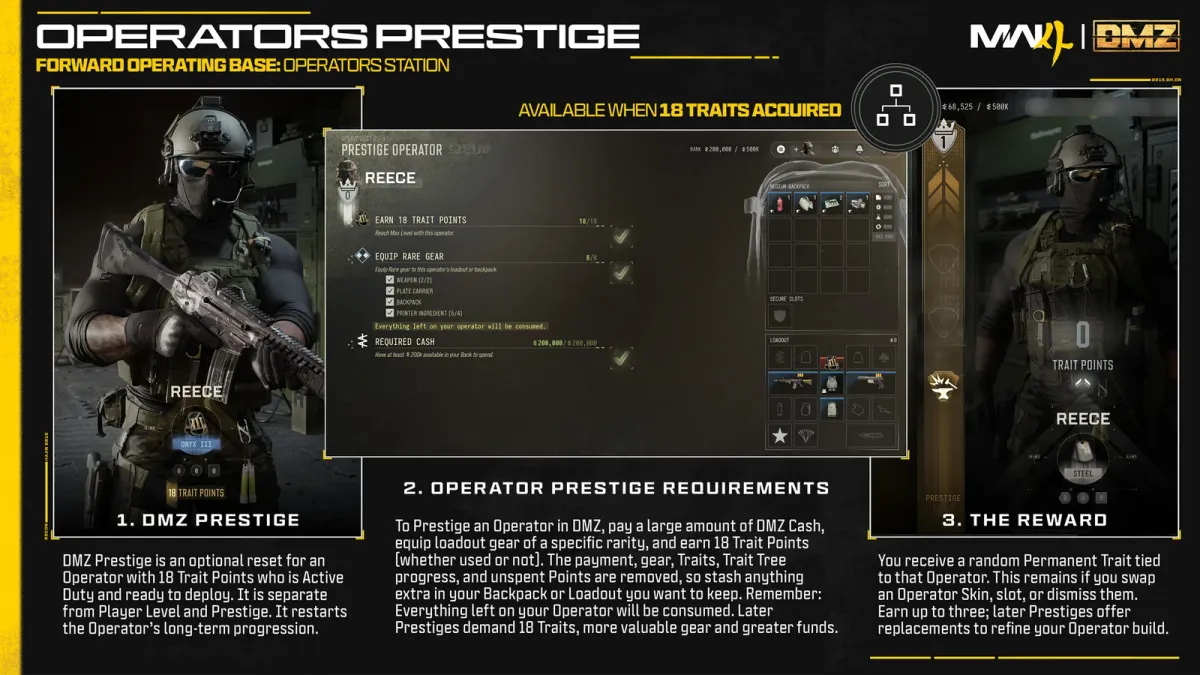
According to Activision’s guide, once an Operator has earned all 18 Trait Points (they do not need to be spent) and is not MIA, you can Prestige them. It is separate from the 1 to 55 player Prestige, the 1 to 70 DMZ track and every other MW4 Prestige system. The table below is Activision’s list, and the requirements escalate with each Prestige. The in-game screen for the first Prestige asks for 18 Trait Points, two Rare weapons, a Rare Plate Carrier, a Rare Backpack, four Rare printer ingredients and $200,000 in your Bank, and does not mention attachment slots. In practice the weapons matter, because Infinity Ward’s workaround for the Prestige issue asks for Rare weapons with three attachment slots. Your Bank holds $100,000 at the start, so you need Bank Upgrade I from the 3D Printer ($20,000, raises the cap to $250,000) before you can even hold the $200,000.
| Prestige | Gear sacrificed | DMZ Cash |
|---|---|---|
| First | Two weapons with three attachment slots, Rare Plate Carrier, Rare Backpack, four Rare Printer Ingredients | 200,000 |
| Second | Two weapons with four attachment slots, Epic Plate Carrier, Epic Backpack, four Epic Printer Ingredients | 300,000 |
| Third and every one after | Two weapons with four attachment slots, Legendary Plate Carrier, Legendary Backpack, four Legendary Printer Ingredients | 500,000 |
Everything in that Operator’s Loadout and Backpack is lost when you Prestige, so empty out what you want to keep. In return their Traits reset and they get a random Permanent Prestige Trait that stays with them through dismissals, slot changes and skin swaps. An Operator can hold three, and all twelve Prestige Traits are in our traits guide. From the fourth Prestige onward you are offered a new one and choose whether to swap it for an existing one or keep your current three. Prestiging multiple Operators also earns Calling Cards and rewards Activision lists as [CLASSIFIED].
Gunsmith and Weapons
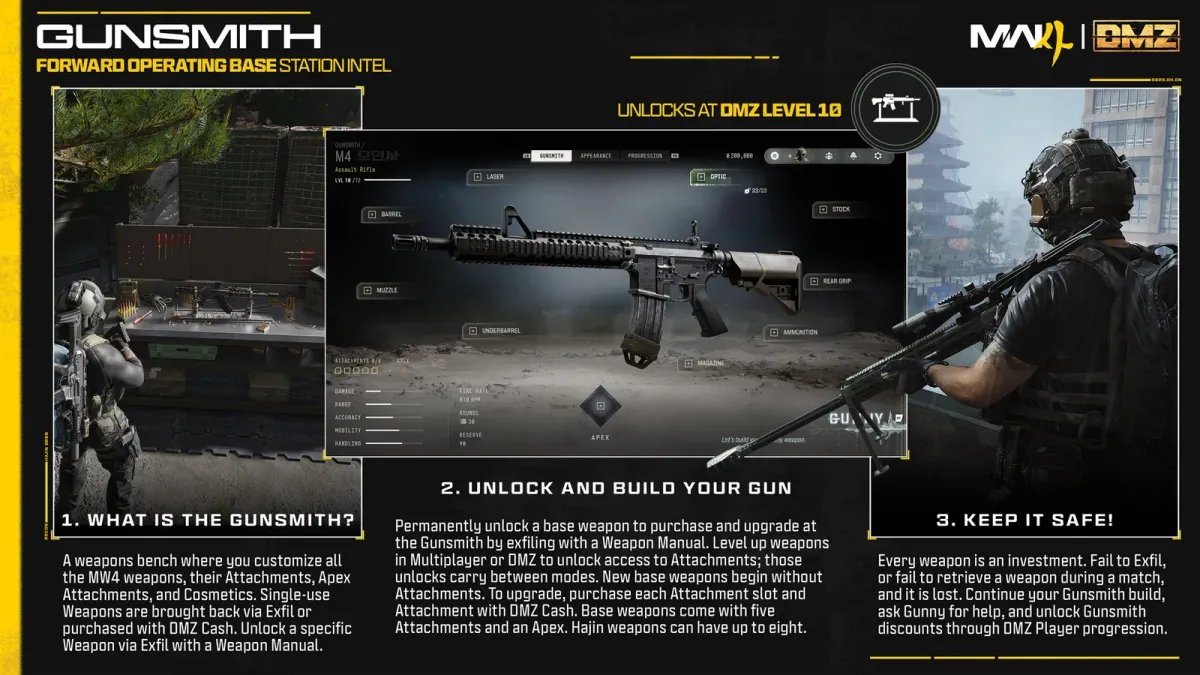
The Gunsmith works like Multiplayer with one big difference: weapons and attachment slots cost DMZ Cash. Weapon levels are shared across MP and DMZ, so anything you have unlocked in Multiplayer is available here. Any weapon you extract with can be brought into the Gunsmith as a single instance and upgraded, but to buy a base weapon outright you first have to find and extract with its Weapon Manual (which, like Recipes, pays 5,000 DMZ Cash on exfil). After that you can buy it as often as you like.
The DMZ Gunsmith lists all 33 launch weapons in nine classes: eight assault rifles, five SMGs, two shotguns, three LMGs, three marksman rifles, three sniper rifles, four pistols, four launchers (which get no attachments) and one combat knife. Build costs run from $250 for the combat knife and $1,000 for the Sang 9mm and Krait P68 up to $50,000 for the JOKR launcher, and a base M4 is $6,250. A locked weapon tells you its manual turns up more often in military containers and safes. Attachment slots cost cash to open, and Activision says there is also an Apex Attachment slot that is free once the weapon is levelled. According to Activision, weapons found in Hajin can carry up to eight attachment slots, which makes Lieutenant drops and rival Operators’ guns the best loot in the zone. Camos, charms, stickers and decals are free to apply.
Two Activision tips that will shape the meta: a Weapon Backpack adds a weapon slot, so you can bring a third gun out (or drop a built one for a squadmate), and every Blueprint you own gets one free use in DMZ, then can be bought back at a discount if you lose it.
Release, Platforms and Editions
DMZ opened in Early Access on Tuesday October 20 for anyone who pre-ordered a digital edition of Modern Warfare 4 (Standard Digital or Vault Edition) on Xbox Series X|S, Xbox on PC, PlayStation 5, Battle.net, Steam or Nintendo Switch 2. The Campaign opened on Friday October 16, and the full launch, including Multiplayer, followed on Friday October 23. DMZ was playable three days before Multiplayer, the opposite of the original, where DMZ arrived as an add-on to a Warzone launch. Infinity Ward’s roadmap puts Season 1 on November 6, 2026.
Hajin in Warzone
A lot of people searching for the Hajin map want to know whether it is the new Warzone map. It is, but not on launch day. At Call of Duty: NEXT on August 21, Activision confirmed that “the DMZ map Hajin is also coming to Battle Royale”, arriving in Season 1 together with Zodiac, a new Resurgence map built by Beenox with a train running through it. Infinity Ward’s October 14 roadmap puts Season 1 for MW4 and Warzone on November 6, 2026. Until then Hajin is DMZ-only, apart from Imjin Farmland and Wolves Stadium, which also ship as Multiplayer Combat Outpost maps.
Expect the Battle Royale version to play differently. Activision has already noted that vehicles need repair and refuelling in DMZ but not in Warzone, and the threat levels, Lieutenants, Commanders and radiation described in this post are DMZ systems. How much of the rest carries over has not been shown. Everything you learn about the layout in DMZ from October 20 onward is a head start for Warzone, which is the first time the extraction mode gets the map before the battle royale does.
What Changed from the Original DMZ
For anyone who played the 2022 DMZ, here is what is different based on what we have played since October 20 and what Activision has shown:
| Feature | Original DMZ (2022) | MW4 DMZ (2026) |
|---|---|---|
| Map | Al Mazrah (borrowed from Warzone) | Hajin (built for DMZ, larger than Al Mazrah, 13 major POIs, 60+ named locations; Warzone gets it in Season 1) |
| Map at launch | Al Mazrah complete, new maps added later | Hajin minus the Russian border, which arrives in later seasons |
| Threat | Basic enemy spawns | Per-POI threat levels from Low to Extreme, a hostiles killed counter, Stealth Meter |
| Bosses | Chemist, Juggernaut-style HVTs | Named Lieutenants with dog tags and loot rooms, roaming Commanders (Colossus, Deathstalker, Tank) |
| Missions | Faction missions with basic objectives | Story Missions in live servers, Dynamic Ops with randomized steps, DMZ Orders, Side Ops |
| Progression | Basic XP and weapon unlocks | DMZ Level 1 to 70, Dog Tag ranks, three Trait Trees, Operator Prestige |
| Crafting | In-match 3D printers only | FOB 3D Printer with Recipes, four Resources, Ingredients, permanent FOB upgrades, plus field printers |
| Looting | Random crate spawns | Location-themed loot (police, fire, clinics, compounds), Secure Slots |
| Weapons | Contraband and insured slots | Gunsmith for DMZ Cash, Weapon Manuals, 33 launch weapons, up to eight attachments on looted guns |
| Infil | Random spawn | Free ground drop up to a 100,000 cash cargo plane you can aim |
| PvP | No structured bounty system | Wanted after four kills, Bounty Stations, Top 50 weekly boards, Dog Tag Case |
| Recovery | Lose everything on death | Paid MIA rescue, Tourniquet, Medkit, dragging, Secure Slots |
| Plea system | Dead players could plead for pickup by rival squads | Not mentioned in any official guide, and we have not found a way to plea. Truce and assimilation confirmed via Ping Wheel |
| Proximity Chat | Basic implementation | Distance falloff, directional audio, environmental reverb |
| Price | Free-to-play (via Warzone) | Part of Modern Warfare 4, which you have to buy, playable since Early Access opened on October 20 |
Cecot was honest about the original back in June: “Looting didn’t feel as purposeful or meaningful.” The 2022 version borrowed its map from Warzone, which limited what the mode could be. This time the order is reversed: Hajin was built for DMZ and Warzone inherits it.
Original DMZ players also get something back. MW4 unlocks special DMZ Beta emblems and calling cards for anyone who played the Modern Warfare II DMZ Beta, put 50 or more hours into DMZ, or finished the Serpentine camo challenge.
Our Take
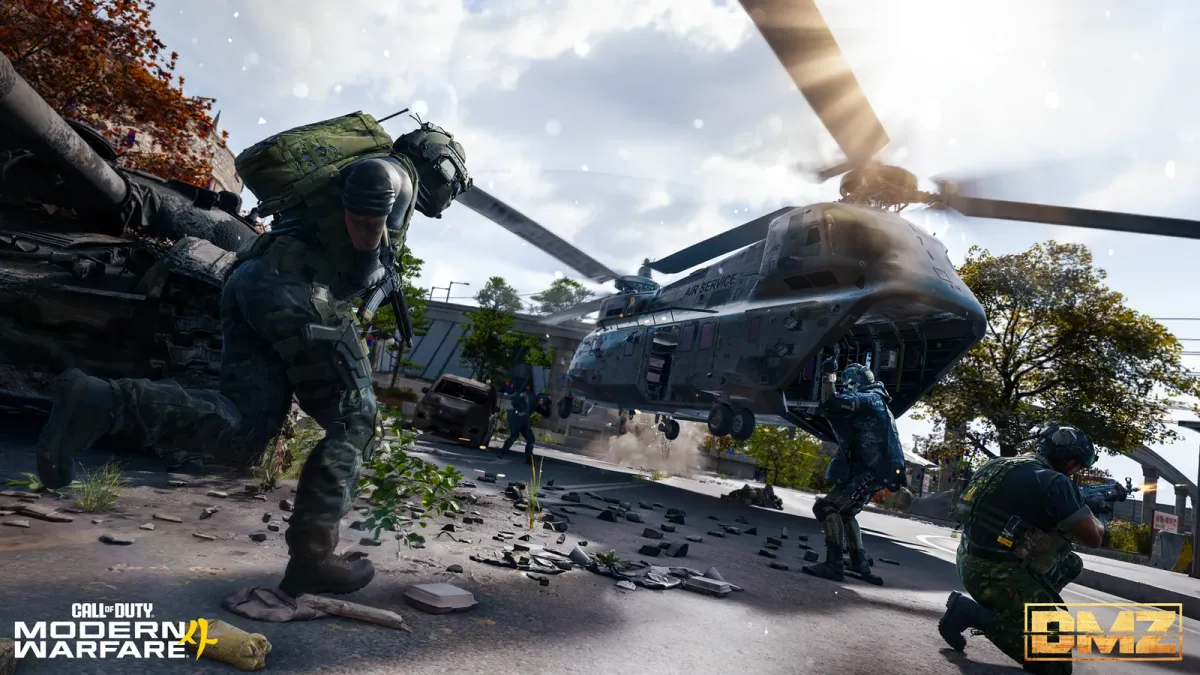
This is the most ambitious third mode Call of Duty has ever attempted. The FOB alone has more systems than some standalone extraction shooters ship with at launch. Story missions running inside live matches is something no other extraction game has tried, Operator Prestige should give the mode a long tail the original never had, and the bounty system creates a natural risk-reward loop that could keep PvP interesting for months.
The October guides also answered the two things we were most worried about. The FOB is real, walkable and gated sensibly rather than dumped on you at Level 1, and the threat system is readable, with a level under your compass that cools off if you disengage. That is a mode designed for people who want to play slow as much as for people who want to fight.
We have played DMZ since Early Access opened on October 20, including all six Story Missions, eleven different Dynamic Ops, a Lieutenant hunt on the Boss Board and two MIA rescues. The threat levels, FOB unlocks and Orders flow match what Activision described closely, and where the game differs we flagged it in the sections above. The concerns are still real though. The extraction shooter audience is skeptical after 2022, and this has to hold up against games people have been playing for years. The harder extraction pivot is real too. Rescue costs that went from $13,000 to $65,000 for the same Operator, gear that only survives in Secure Slots, and the reported removal of pleas (we have not found a way to plea either) mean the casual “full send into every fight” playstyle from the original will not survive contact with Hajin. Original DMZ players are openly questioning whether the new direction is for them, while extraction fans see exactly the correction the mode needed.
The seasonal map plan pulls the same way: holding back the Russian border treats Hajin as a place with chapters rather than a map you learn once, which is the right instinct for a mode built on discovery, but it means launch has to be strong enough to keep people around before the next chapter lands. The original DMZ was carried by its own weirdness for a year without a plan. This one has a plan and less room to be forgiven.
We are cautiously optimistic, and the bounty system is the reason. DMZ was never meant to be a fully focused PvP mode, and punishing player-hunters harder than the original did makes it more fun and more chill for the casual majority. What we need from Hajin is the surprise that makes DMZ special, especially when you are trying to extract. The bounty system is also the part we have seen least of, because the bounty station in Deadtown had nobody Wanted when we checked it in Early Access. The full launch on October 23 brought everyone else in, and the weeks after launch are when we will judge it.
If you want to see the mode in motion, watch the official First Look gameplay trailer from the Xbox Games Showcase, then read Activision’s two October guides on Hajin and the FOB. For a broader overview of MW4’s campaign, multiplayer and other confirmed features, check our MW4: Everything We Know breakdown.
Want to discuss DMZ with players who actually played the original? Join 50,000+ members in our COD Central Discord. Our MW4 Discord page explains how squad LFG works for DMZ.
Frequently Asked Questions
Is MW4 DMZ free?
No. DMZ is a mode inside Modern Warfare 4, not a separate free download. Activision's October 15 announcement says Modern Warfare 4 is a standalone release that you have to buy to play, and that it will not be included with Game Pass until Holiday 2027. Activision has not announced a free-to-play version of DMZ. That is different from the original DMZ, which was free through Warzone 2.0.
Is MW4 DMZ PvE or PvP?
Both, so PvPvE. Activision describes DMZ as a mode where you fight both AI enemies and rival Operators. Every deployment has AI-controlled North Korean forces, drones, Lieutenants and Commanders, plus other squads of real players who can fight you, leave you alone or call a Truce through the Ping Wheel. Killing rival Operators earns you a Bounty that follows you across deployments.
Can you play MW4 DMZ solo?
Yes. Activision says you can approach every deployment within a squad or acting alone. Squad Fill is a toggle in the Ready Up menu, and switching it off deploys you without random teammates. The one exception is Random Story Mission, which always uses Squad Fill. Solo players share Hajin with full squads, so the Stealth Meter and a threat level that cools off when you break contact matter even more.
How many players can be in a MW4 DMZ squad?
You deploy in a squad of up to three Operators, either with your own party or with Squad Fill filling the empty spots with other players. During a deployment the Ping Wheel lets you invite nearby players to join your squad or ask to join a nearby squad, and that way a squad can grow to a maximum of four. We finished Operation Signal Breaker in Songdo Wharf as a squad of four.
How many players are in a MW4 DMZ match?
We cannot tell you, because the game does not show a player count anywhere and Activision has not given one for DMZ. What we can say is that every deployment has other squads of real players besides the AI, and that Infinity Ward built Hajin larger than Al Mazrah partly to spread squads out.
Is MW4 DMZ third person?
No. On foot in Hajin you play in first person, the same as Multiplayer. The FOB between deployments is a camp you walk around in third person, and in Hajin we drove vehicles from a third-person camera. None of the three deployment options (Story Missions, Dynamic Operations and Free Roam) is a third-person mode.
Does MW4 DMZ have bots?
Yes, as enemies. Hajin is full of AI-controlled North Korean soldiers in four tiers, drone swarms, robot dogs, helicopter patrols and road convoys, plus named Lieutenants and three types of roaming Commander. There are no AI teammates. Squad Fill matches you with real players, and the rival Operators you run into are real players too.
What happens when you die in MW4 DMZ?
Your Operator goes Missing In Action and you cannot deploy them until you pay to rescue them at the Operators station. A rescue brings back their Traits, unspent Trait Points and Dog Tag rank, but most of the loadout is gone, apart from what sat in a backpack's Secure Slots. Rescuing our Army SF Airborne Operator cost us $13,000 at Silver I and $65,000 later at Damascus III. You can also dismiss them and recruit a new one, and any DMZ XP from the failed run still counts.
Is MW4 DMZ a separate game or a mode?
DMZ ships as a mode inside Modern Warfare 4 alongside Campaign and Multiplayer. It is not a standalone game. Infinity Ward co-studio head Jack O'Hara confirmed that DMZ does not replace battle royale. Warzone stays separate.
When did MW4 DMZ come out?
DMZ opened in Early Access on Tuesday October 20, 2026 for anyone who pre-ordered a digital edition (Standard Digital or Vault Edition), four days after the Campaign. Everyone else got it with the full launch on Friday October 23, 2026, on PS5, Xbox Series X|S, Xbox on PC, Battle.net, Steam and Nintendo Switch 2. Season 1 starts on November 6, 2026.
How big is the MW4 DMZ map?
The Hajin Exclusion Zone is larger than Al Mazrah from Warzone 2.0. Activision's October tour lists 13 major points of interest, more than 60 named locations in total, and hundreds of buildings. The map covers former North Korean and South Korean territory, with the Russian border across the Hajin River currently inaccessible. The same map comes to Warzone Battle Royale in Season 1.
Is the whole Hajin map playable?
No. The Russian border north of Cheongun Village is described as fog-filled and currently inaccessible. Infinity Ward co-studio head Mark Grigsby confirmed in July 2026 that the Russian portion will be added in later seasons. No season or date has been given.
What are Traits in MW4 DMZ?
Traits are per-Operator upgrades. Each time your Operator's Dog Tag levels up (18 levels from Steel I to Onyx III) you get one Trait Point, so an Operator can earn 18 points in total. You spend them across three Trait Trees: Warfighter, Scout and Survivalist. There are 66 Traits in total, 22 per tree, and picks are locked in once chosen.
How does Operator Prestige work in DMZ?
Once an Operator has earned 18 Trait Points you can Prestige them, as long as they are not MIA. You sacrifice two weapons, a Plate Carrier, a Backpack and four 3D Printer Ingredients of a set rarity plus DMZ Cash (200,000 for the first Prestige, 300,000 for the second, 500,000 from the third onward). The Operator's Traits reset and they get a random Permanent Prestige Trait that stays with them forever. An Operator can hold up to three Permanent Prestige Traits. That is how Activision describes it. As of October 27, Infinity Ward lists the Prestige Operator button as a known issue on its Trello board, because some players cannot Prestige an Active Duty Operator even with every requirement met. Its workaround is to equip Rare (blue) weapons with only three attachment slots, weapons that have never had four or more attachments on them.
How does the bounty system work?
Killing a rival Operator immediately puts a Bounty on your Dog Tag. According to Activision, four Operator kills across deployments make you Wanted, and nearby players are automatically alerted when you come close. Hunters can buy intel at a Bounty Station in Hajin to see your general area, and they collect the Bounty by killing you and extracting with your Dog Tag. You lose your Bounty by dying, by losing your Dog Tag to another player, or by paying it off at a Bounty Station. The FOB has a Top 50 Most Wanted and a Top 50 Bounty Hunters leaderboard, updated weekly.
Does weapon progression carry over between DMZ and Multiplayer?
Yes. Weapon levels are shared between Multiplayer and DMZ, and attachments you unlock in one mode are available in the other. In DMZ you still pay DMZ Cash to build a weapon in the Gunsmith, and you need to extract with that weapon's Weapon Manual before you can buy it there.
What is the Forward Operating Base in MW4 DMZ?
The FOB is your persistent hub between deployments. From day one you get Operators, DMZ Orders, Stash/Loadout, Firing Range, Survival Kits, Bounty Leaderboard, DMZ Progression, Events and Deploy, although your first deploy is a Dynamic Op and Story Missions unlock after your first page of DMZ Orders. The 3D Printer unlocks at DMZ Level 2, the Boss Board once you finish the second page of DMZ Orders, the Vendor at Level 5, the Gunsmith at Level 10 and the Dog Tag Case at Level 20. The FOB also expands visually as you progress.
How does crafting work in MW4 DMZ?
Loot you pick up in Hajin breaks down automatically into four Resources (Synthetics, Electronics, Chemicals, Metals), which do not take up Stash space. Rarer 3D Printer Ingredients such as Binding Catalyst or Biomaterials are extracted intact. Back at the FOB, the 3D Printer combines Resources and Ingredients into gear using Recipes, which you unlock through DMZ levels, DMZ Orders or by extracting with a looted Recipe. The printer also crafts permanent FOB upgrades.
Is Hajin coming to Warzone as the new Battle Royale map?
Yes, but not at launch. Activision confirmed at Call of Duty: NEXT on August 21, 2026 that the DMZ map Hajin is also coming to Warzone Battle Royale with Modern Warfare 4 Season 1, alongside Zodiac, a new Resurgence map built by Beenox. Infinity Ward's October 14 roadmap dates Season 1 for MW4 and Warzone on November 6, 2026. Until then, Hajin is only playable in DMZ (and two of its POIs, Imjin Farmland and Wolves Stadium, as Multiplayer Combat Outpost maps). Activision has also said vehicles need repair and refuelling in DMZ but not in Warzone, so expect the two versions to differ.
